Monday, November 06, 2006

Meeting the Man

Permit me for five minutes to act my shoe size and not my age...

As some of you may know, Sir David Attenborough and his work have been a lifelong inspiration for me.

Those closer to me know that I don't stop going on about him...

During my childhood I was enchanted by his personable accounts of the rich natural histories that surround us. I am still enchanted. My career is as a result of his work, and I follow in his footsteps, albeit at a considerable distance.

It has been my wish, for the longest time, to thank him. So it was with much trepidation and a belly full of rare and exotic butterflies that I finally had the opportunity to meet Sir David in person...

On Sunday morning Siva, the Otterman, called me and asked if I was free for half an hour. The BBC Natural History Unit had been in Singapore filming sequences (for their upcoming Life in Cold Blood series), and Siva in his capacity as mangrove expert, had been helping out.

Siva: "David Attenborough is in town - maybe you'd like go meet him this evening before he flies out?"
Charith: "Wow"
S: "He's pretty tired but there should be enough time to say 'hi' before he leaves"
C: "Wow"
(my shoe size is 10 by the way)
S: "Ok, so see you later then"
C: "Wow"

So about four hours later, after regaining my composure, I grabbed my copy of "The Life of Birds", and made it through a weekend traffic jam just in time to meet Sir David before he left for Australia.

It must have been a five minute conversation - we discussed Sloth Bears, Macaques and his next shoot in Sri Lanka. I must have also blurted out my admiration for him at least three times during that space of time. But that's okay, 'cos I'm a ten year old kid at this point. Inspite of my blubbering he was most gracious and signed my book too.


"See you later, Sir David" (thanks Siva for the photo)

So there you have it - an opportunity of a lifetime. I told Siva in all honesty, that he had made my decade... I have certainly been rejuvenated by the experience.

Hopefully I won't have to wait another thirty years to meet David Attenborough again...

wildlife news: Macedonia Lynx fights for survival

It's considered a national symbol, displayed on the back of Macedonia's 5-denar coin.

But the Balkan lynx, the largest of European wildcats, is a very rare sight in the southern Balkans these days.


Conservationists say only about 100 remain scattered across the region, making it Europe's most endangered wildcat, and they're mounting an urgent effort to save it. The cat roams the rugged hills of western Macedonia and is also found in parts of Montenegro, Albania, Serbia and Greece.

Macedonia is home to the largest number, about 30 - not nearly enough to stave off extinction, experts fear.

Read more

Sunday, November 05, 2006

artwork: cheetah

What does a wildlife-lover do when he is on medical leave and can't go out into the wilderness or have fun getting lost in the jungle?

Well, MC is no fun for someone like me. So I decided to deal with the boredom by going back to one of my first loves and starting my artwork again, which I've been neglecting for some time.

So here goes, after a week or so of meditative artwork, here's my latest piece. The cheetah is a practice run, combining watercolour and pastel - I will be turning my attention to asiatic species next...


Tuesday, October 31, 2006

Season of the Spirit Bear


Hello All, apologies for the absence - illness and a bit of enforced rest have kept me away for a while, but enough about that. I am delighted to announce that Season of the Spirit Bear will be premiering in this part of the world (Asia and South East Asia) on 26th November.

Check out this Animal Planet link for more details.

Internationally, it'll be airing on the 18th November in the UK and Europe, and on the 26th in Australia and New Zealand. It will also be airing in Latin America during November, but I still don't have dates for that region. Anyway it'll be repeated several times during the month.

Happy viewing!

Unfortunately the show is not being aired on Animal Planet US, as their schedule seems to be fully booked for the foreseeable future. But maybe if any of you in the States would like the opportunity to watch it, you could make a request to the nice people at AP! Again my apologies, as I know quite a few people over there who have been waiting patiently to watch it...

on the subject of bears...

Friday, September 01, 2006

back from the brink

Well its been almost two whole months since my last entry. Time flies when you're having fun...

Actually after days and nights of frantic editing and frequent pacing of the edit room floor and myriad instances waking up and pleading to no-one in particular, "Why the hell did I choose to make a film with Animal Planet about the most endangered (and therefore most elusive) mammal species in Sri Lanka?" - the job is done (almost).

"Season of the Spirit Bear" will be a thing of reality and celluloid and in Animal Planet's safe hands next week. Its been a blast, its been a bloody nightmare, its given me sleepless nights and times of doubt...

To many seasoned wildlife film-makers, its just another job in the can, but for many reasons this project is important to me. Come November when it finally goes on air, I hope that at least a fraction of that meaning will be conveyed on screen. I will post more details about times when I get them.

But in the mean time - its good to be back. I have got a little tired of sleepless nights!

Cheers
C.

Tuesday, July 04, 2006

A sad day for an animal man...

After escaping ambush from Asiatic Lions, a near-squashing from angry elephants, a close-shave with a giant Stingray and being defecated on by a family of Flying Foxes... I've finally been injured by an animal - well quite a few animals actually.

It is a sad day indeed:


Last night two of my cats decided to have a fight, and the dogs joined in.

Unfortunately the site of said fight was on top of my head, while I was asleep in bed.
I now have three vicious looking slash marks on various areas of my bald expanse... can't decide whether I look like I've just had a lobotomy or just look stupid. Bandanas and bandaids for a couple of weeks...


Jelly says "It wasn't me"
(this is true)


Monkey says "It wasn't me"
(this is not true)

Wednesday, June 21, 2006

Field Journals: Sloth Bears

As some of you may know, I've been busy with a documentary about Sloth Bears on the island of Sri Lanka.

Have been in the process of getting all my footage sorted out, but I'd like to share some of my experiences here - and share with you just what its like to be in the wilderness away from Humanity for a few precious days!!! (I need it from time to time, and fortunately my job allows me to do just that!)

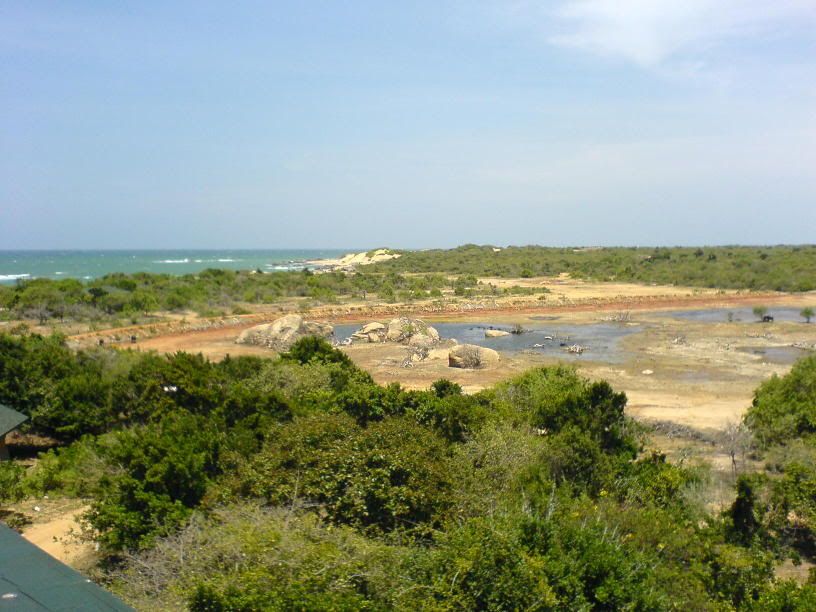
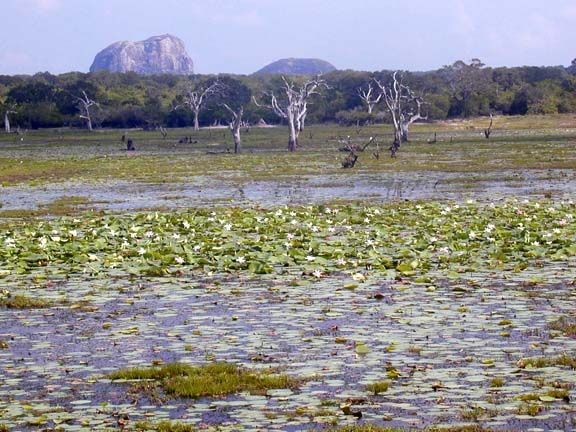
Here is the location where the crew was based... a little piece of heaven on the south-east coast of the island!


For obvious reasons I can't post too many visuals from the shoot just yet - technically it all belongs to Discovery! - but I will selectively post some of my own digital photos and sketches up here.

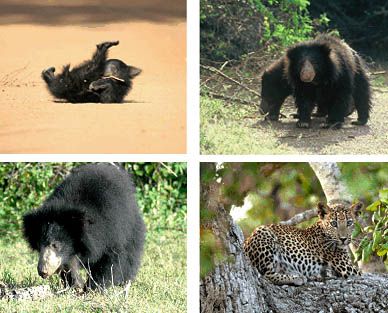
Although the subjects of my documentary are highly endangered Sloth Bears, of which there are fewer than 300 left in Sri Lanka, we do have a strong supporting cast!

Sri Lanka is still one of the best places to see Leopards in the wild, and they obliged on our shoots too.


As for the bears, there were signs of them everywhere - claw marks on trees, pugmarks in the dust. Problem is that they are most active at dawn - so the crew had to get special permission to access the deeper parts of the reserve at 4:30 in the morning... no more late nights!

First positive ID of a bear was a sighting of a young male splashing his paws lazily in a rock pool - looked like he was just amusing himself with the ripples - but then the tracker said this particular bear was splashing deliberately to try and scare the frogs out - catching them as they leapt into the air! Never heard of this behaviour before.

Well he didn't seem to have any luck on this occasion, and in any case the light was too poor to film.... one of those wildlife moments which will have to be recorded to memory rather than onto film! You get used to these little disappointments...

Of course the best thing about doing this job is when everything happens like clockwork - for the first time ever - we were getting more leopard sightings than bears (usually when I REALLY want to film leopards - they never turn up...)


But the bears finally showed - I had researched their behaviour for the past couple of years, and had already gambled on the fact that this time of the year would be the best bet to see them.

The bears had arrived, and the leopards were keeping watch too. Finally we seemed to be in the right place at the right time. I had been planning this story for almost ten years, and finally things were starting to happen...

Sunday, June 18, 2006

'Fossil' rock rat pictured alive

Hello All,

Apologies for the long absence - have been busy with my Animal Planet project, but have found enough respite from my schedule to get back to the blogger!

A fascinating update about a fossil rodent-like creature whose carcass had recently been found in a Laotian meat market, believed to have become extinct 11 million years ago (!):

Images have been obtained of a live Laotian rock rat, the animal science now believes to be the sole survivor of an ancient group of rodents.

The kha-nyou, as it is known locally, was trapped by an expedition in May. The pictures show a friendly, furry creature about the size of a squirrel that waddles a bit like a duck.

Experts say the kha-nyou can trace its line to a rodent family that initial studies had suggested became extinct more than 11 million years ago.

The expedition to central Laos was led by a retired Florida State University scientist, David Redfield.

"We were extremely fortunate in so many ways to be able to do this," he said of the discovery. "It's easily one of the most gratifying experiences of my life, and I hope these pictures will help in some way to prevent the loss of this marvellous animal."

The kha-nyou was picked up near the village of Doy, close to the Thai border. It was released back into the wild after being photographed and videoed.

Now classified as Laonastes aenigmamus , the animal first caught the eye of international researchers last year in a hunters' market - dead specimens were on sale.

Based on differences in the skull, teeth, bones and other body features together with DNA analysis, scientists initially put the creature in an entirely new rodent family more closely related to rodents in Africa and South America than in Asia.

But then a particularly impressive fossil of a long-extinct rodent was unearthed in China last summer, and that prompted experts to wonder whether the kha-nyou might be a living member of the long-gone family.
They went back through the fossil evidence and found that the kha-nyou's skull, teeth, lower jaw-bone and other skeletal characteristics were a striking match to the fossil.

The latest thinking is that the Laotian rock rat belongs in the same group - the otherwise extinct rodent family Diatomyidae.

Mary Dawson, curator emeritus of vertebrate palaeontology at the Carnegie Museum and primary author of the scientific paper which made the re-identification, has reviewed the latest images.

She has confirmed their authenticity. "This is a truly exciting discovery," Dawson said. "Dr Redfield's sighting of the living animal is the first to be recorded scientifically. These are the first photographic images of the recently discovered 'living fossil' Laonastes aenigmamus."


The animal was trapped and then released
(Image: D. Redfield).

Wednesday, May 03, 2006

Jungle Survival Kit: Vodka

As I prepare for an upcoming shoot, I'd like to share with you an unlikely but useful part of one's field kit: Vodka

Some of Vodka's many uses:
1. To remove a bandage painlessly, saturate the bandage with vodka. The solvent will dissolve the adhesive.

2. To clean your eyeglasses, simply wipe the lenses with a soft, clean cloth dampened with vodka. The alcohol in the vodka cleans the glass and kills germs.

3. Prolong the life of razors by filling a cup with vodka and letting your razor blade soak in the alcohol after shaving. The vodka disinfects the blade and prevents rusting.

4. Spray vodka on vomit stains, scrub with a brush, and then blot dry.

5. Using a cotton ball, apply vodka to your Face as an astringent to cleanse the skin and tighten pores!

6. Fill a sixteen-ounce trigger-spray bottle and spray bees or wasps to kill them - apparently, I haven't tried this one out - usually too busy trying to tackle the leeches - and of course I wouldn't encourage the harming of bees or wasps if I could help it in the first place.

7. Pour one-half cup vodka and one-half cup water in a Ziploc freezer bag and freeze for a slushy, refreshable ice pack for aches, pain or black eyes.

8. To relieve a fever, use a washcloth to rub vodka on your chest and back as a liniment.

9. To cure foot odor, wash your feet with vodka.

10. Vodka will disinfect and alleviate a jellyfish sting.

11. Pour vodka over an area affected with poison ivy to remove the urushiol oil from your skin.

12. Swish a shot of vodka over an aching tooth. Allow your gums to absorb some of the alcohol to numb the pain.

These tips work - and if for some reason they don't, you'll still end up feeling quite happy about trying them out anyway.


vodka: good for vomit... stains

Monday, April 24, 2006

"Eagle Eye Cam!"

Check out this amazing streaming live "Eagle Eye Cam" from a bald eagle's nest in Hornby Island, British Columbia, Canada.

EAGLE EYE CAM

The eggs are about to hatch and the local wildlife department are monitoring the pair.

The eagles have nested on a protected, privately owned piece of land so they are safe from harm.

Sunday, April 23, 2006

Environment News: 20 years later, wildlife thrives at Chernobyl

Nature's capacity to heal itself is absolutely incredible. I for one believed that Chernobyl would forever be a "No-Mans Land" - but obviously the animals don't seem to have paid much attention...

With lynx, wolves, eagles and wild horses, the radioactive no-go zone around Chernobyl has become a rich natural reserve in the 20 years since the accident at the nuclear power plant.

Dangerously soaked with radiation following the April 26, 1986 accident at the then Soviet plant, some 4,000 square kilometres of land surrounding the Chernobyl plant were evacuated and closed to humans.


In the two decades since, Mother Nature has had nearly free reign over this patch of land straddling the border between Ukraine and Belarus. The results have been impressive.


Take for example the famed Przewalski's horse, believed to be the only true modern descendant of the wild horse. In 1998, 17 of them were introduced to the area.


Today officials who accompany visitors to the zone say the steeds number between 80 and 90, and the area around Chernobyl is one of the few places in the world where they still roam free.

Nearly completely unperturbed by man — some 350 "self-settlers" still live inside the zone, but this mainly elderly group generally keeps to its eight villages — the flora and fauna here have developed with virtually no human interference.
In one day, a lucky first-time visitor may see elk, foxes, otters, beavers, wild boars, gray cranes and endangered great spotted eagles. Regular visitors say bears have also been spotted in the area.

With so few people, the zone is the perfect habitat for endangered species. The Chernobyl International Radioecology Laboratory has so far recorded the presence there of more than 400 animal species, including 280 kinds of birds and 50 endangered species.


And despite apocalyptic predictions at the time of the Chernobyl disaster, the animal species living inside the forbidden zone are not strange, disproportioned mutants.
"The mutants never resembled the monsters described in the media and all died out quickly," said Sergei Gashak, an ornithologist at the Chernobyl lab.

The ecosystem surrounding Chernobyl has passed through several stages since the accident.
During the first year-long phase, plants and animals that were most affected by the radiation died. Some areas were so soaked with radioactivity that they had to be completely razed, such as a pine forest that became known as the "Red Forest" for the levels of radiation registered there.

Over the next six years, nature slowly licked its wounds following the disaster, he said.
Today it is coming back with a vengeance. The Chernobylinterinform — the state enterprise that provides the obligatory guides for all visitors — claims that the pines planted in place of the "Red Forest" are thriving.

Along with the recovering flora and fauna, a tourism industry has taken root. Hundreds of human visitors have come since the authorities began accepting tourist groups three years ago.


The curious have mostly come from abroad and have included Americans, Germans and Japanese, guides say.
They usually come in small groups during the summer, to be driven by guides to take a look at the power plant and at a village of the mostly elderly who have shrugged off government restrictions and radiation levels to return to the place they lived prior to the 1986 accident.

Most tourists have a moribund fascination with the town of Pripyat, which counted 45,000 residents at the time of the accident but that today is a Soviet ghost town overrun by vegetation.
Among the most bizarre visitors was a newly married couple who wanted to end their honeymoon in the city.

Many of the people who work in the zone in up to 15-day stints hope that a protected natural preserve can someday be established here.
But even after two decades signs remain that this is no ordinary wilderness zone.

There are checkpoints on entry and access is still forbidden to areas considered the most contaminated; the cemetery of buses, fire trucks and helicopters that helped evacuate the zone's residents and today are awaiting incineration; and the frequent beeps of the dosimeter every time the level of the surrounding, invisible radiation jumps.

And there is of course the radiation itself: invisible, odorless, tasteless, it permeates the buried buildings, cars and cattle, the earth that covers them, the rivers that flow nearby.

And it will do so for a long time to come.

Wednesday, April 12, 2006

Pointless Science #3: Mouse sheds light on regeneration

Regeneration - the ability to recreate lost or damaged cells, tissues, organs or even limbs - has a limited capacity in mammals. While skin and hair cells constantly renew themselves, unlike a newt, if a human loses a leg, there is no second chance.

But the discovery of a strain of mouse, the Murphy Roths Large (MRL), with remarkable regenerative capabilities has opened up the possibility that those properties could be transferred to other mammals.


Professor Ellen Heber-Katz, a scientist from the Wistar Institute in Philadelphia, US, was part of the way through an immunological study when she first stumbled across the MRL mouse's amazing abilities.
She was looking at the effects of a drug, and had marked the mice that had received the drug by punching a small hole in their ear to distinguish them from those who had not.

"I went upstairs and I looked in the cage, but none of the mice were marked," she said. "I looked at them and thought: 'what's happened?' I thought the post doc hadn't done the experiment.

"So we did it again, and we watched them, and there it was - the holes had closed up. I thought, 'Oh my God, this is just amazing'." When they looked closer they saw that there had been DNA synthesis, cell proliferation and both cartilage and new hair follicles had also grown.

The MRL mouse has been used in research for years - mostly as a model for autoimmune diseases because the genetic mutations they carry mean they have a lupus-like disease. But the accidental discovery by Professor Heber-Katz of this rapid regrowth opened up a new avenue of research.

After talking to colleagues and realising that this kind of healing had never been seen before in a mouse, Professor Heber-Katz's team switched from immunology to regeneration and began to look at the mouse to see the extent of these regenerative properties.

When the team used a cold probe to make a small injury to the heart of the MRL mice they found that the tissue regenerated and there was no scarring. When they examined what happened after spinal cord injury, again they found cell re-growth and little scarring.

The MRL mouse has even been shown to have some digit regrowth.
"It is known that if you cut off the digit tip in mice it always seems to come back; but if you cut any further, you get no growth. "We did that in the MRL mouse and there is a blastema [area of growth] that forms, there is DNA synthesis and cell proliferation, and we also think that maybe there is the beginnings of a joint that is formed. I must say that we have not seen the whole digit grow back"

The Prof believes that one of the factors that blocks regeneration in most mammals is a membrane that forms as the body starts to repair itself. She points out that when amphibians regenerate their limbs, a basement membrane does not form, but if you promote the growth of this membrane, then it seems to stop cell growth and causes scarring.

When the team looked at the formation of the membrane in the ears of MRL mice, they found that it did form initially, but disappeared soon after and then cell growth begins.
Further work has shown that two genes, mmp9 and mmp2, may be implicated.

The team are now in the process of mapping genes to try and shed more light upon the genetic combinations that may be at the root of the mouse's regenerative process. "It is a long term project, but once we know the molecules involved we can the try to modify them to see if we can get this kind of response in mammals"

The complicated nature of mammals means that we might still be a long way off the day when mammals can begin to display MRL-like regenerative properties, but Heber-Katz says the mouse could provide the first step on the path.

Okay, okay, so this is all very interesting stuff and one day may lead to some revolutionary benefits for incapacitated humans - but am I the only one that realises what these tests implied to the poor MRL mouse?

As if being subjected to autoimmune diseases wasn't enough, their new found place in the scientific spotlight means that now they've got a lifetime ahead of having little bits continuously sliced or cut or drilled from their bodies, just to prove that this theory is... erm, proved.


Scenario - one MRL mouse to another:

"Thank god, that nasty hole in my ear finally healed, its been bugging me for weeks."
"Yeah, and that chest pain I had seems to wearing off as well."
"Great, I can finally lay my head down and get a good night's sleep without my ear hurting."
"And I can actually have a bit of a run on the treadmill without doubling up in pain."
"Hang on a minute, what's that human doing coming over here with those scissors?"
"Hey, he's got hold of my leg! Get those bloody scissors away from me!"
"Oh no - here we go again..."


Thursday, April 06, 2006

Science News: Fossil Fills Land-Sea Animal Gap

If you trace our family tree 370,000,000 years back to the Late Devonian, this could well be the face of our long-lost great grand mother.
Meet Tiktaalik roseae, the newly described lobefinned fish from Nunavut, Canada. The name Tiktaalik comes from an Inuit word for the fish we call burbot, after local elders noted the similarity between the fossil and the large living fish they catch.

Unlike its namesake, however, Tiktaalik is a member of the great fish clan Sarcopterygia. Sarcopterygians achieved enduring fame and glory after certain members evolved the means to crawl out of the water and taking the first steps (literally) to a totally landlubbing lifestyle. Tiktaalik fits into this story quite well, sporting a set of characters more amphibian-like than all other fish, but more fish-like than the earliest amphibians.


The astonishingly detailed fossils were coaxed out of ancient rock just a thousand kilometres (600 miles) from the North Pole, and are helping to explain how, little by little, fish in the sea moved on to the land, evolving into the myriad species of animals that have lived, eaten or been eaten, fought and died on terra firma for more than 300 million years.


Buried in river sediments on Ellesmere Island, the preserved remains of
Tiktaalik have already been described as the "missing evolutionary link" between fish and tetrapods.


The newly discovered species looks superficially like a crocodile, with a skull around 20 centimetres (eight inches) long. Its flattened body, which probably grew to a length of between 1.25 and 2.75 metres (four to nine feet), was covered in diamond-shaped bony scales. It was like a fish, with its primitive jaw and fins, but had a tetrapod's neck and ribs.

What is generating the most excitement about the finds are joints in the fish's pectoral fins, which have bones that compare to the upper arm, forearm and primitive parts of the hand of land-living animals.

"Most of the major joints of the fin are functional in this fish," said Neil Shubin, a professor of organismal biology at the University of Chicago and co-leader of the expedition whose findings appear on Thursday in the journal Nature.

"The shoulder, elbow and even parts of the wrist are already there and working in ways similar to the earliest land-living animals," he said.

The sediment in which Tiktaalik was found has been dated to around 375 million years ago, in the swampy, pre-dinosaur era known as the Devonian.

At that time, what is now frigid Arctic Canada had a balmy, sub-tropical climate, for it was part of a mega-continent that straddled the equator.

Shubin said he believed that Tiktaalik's size and shape indicated that it was suited for living in small streams in a delta system, an environment that probably encouraged the fish to venture into shallow water or even make forays onto land in search of food or shelter from predators. "The skeleton of Tiktaalik indicates that it could support its body under the force of gravity, whether in very shallow water or on land," said co-author Farish Jenkins, a professor of organismic and evolutionary biology at Harvard University. "This represents a critical early phase in the evolution of all limbed animals, including humans — albeit a very ancient step."

Tiktaalik fills a knowledge gap about a key transition period spanning around 20 million years in the Devonian era, between fish and the first tetrapods. Tiktaalik comes between a torpedo-shaped fish called Panderichthys that lived around 385 million years ago and whose pectoral fins and shoulder skeleton suggest it could walk in shallow water but not on land; and the first unambiguous tetrapods, Acanthostega and Ichthyostega, which lived around 365 million years ago and, despite having fishy tails, had limbs with digits.

Acanthostega and Panderichthys

To have... and to have not.

Its a funny old world, isn't it? The circumstances that keep the human race united under the common ties of community - and yet poles apart in terms of commodity.

A couple of weeks ago a sleak black Lamborghini pulled up along side me in town. This admittedly gorgeous piece of machinery is probably one of the most recognizable statements of privilege and wealth on four wheels that you're likely to come across in public. And although my salivary glands were about to go on overdrive, my thoughts suddenly switched to the absurdity of what was sitting there, growling quietly in front of my eyes.

We all know that the distribution of wealth is spread unevenly across the world - and never more so than here in South East Asia. Where else would you find such conflicting scenes of sprawling urban slums sitting shoulder to shoulder with mansions and manicured gardens? Millionaires and misery living side by side. I've lived in this part of the world for almost ten years and I'm still not used to it.

Just three months ago I was in Sri Lanka, and although a beautiful country, its still got enough economical and political obstacles to keep it from reaching its full potential for many decades to come. I recalled another unusual street scene from back then - a working elephant marching along a dusty back street, while closeby a street child begged deliriously for food.

What a contrast to the sleek machine purring at the traffic lights back here in Singapore...

I quickly calculate that the small fortune paid for this car could easily: finance research on an endangered species, restore the livelihoods of entire communities destroyed by the tsunami, and even help fund any number of medical breakthroughs - the list goes on. Of course I'm talking humanitarianism here - a bit of an antique concept these days.

As we evolve as a species, so our notorious Selfish Genes have become more dominant - it seems to be the way of things, across the board. Now don't get me wrong - this is not a jibe against the owner of said supercar (oh yeah... you can almost see the sour grapes spilling from Charith's mouth) - rather its what he stands for; a symbol of where most of the human race would like to be. Its all about possession and prestige - an almost instinctive need that plagues us.

Although my aspirations don't include owning a million dollar sports car, I still want that new camera, that computer upgrade, and eventually a nice little farm in the country. There's always something we want, on any given day.

But if we could just manipulate that little piece of DNA - mutate it, make it more malleable - turn it into an altruistic gene with all traces of selfishness spliced out... yes that's all sci-fi - but what if? What if?

What would it take for us to address the realities of poverty that plague our race even in this so-called enlightened age? What would it take for the millionaire to swap his Lamborghini for a more practical SUV and divert some of his fortune to aid the less fortunate? No, that's not going to happen is it? That's not the way we're built...

So, in Singapore's thriving business district a stockbroker drives into the sunset on his wheels of fortune and a thousand miles away in a forgotten street corner, someone is trying to figure out how they're going to be able to make it through another day.

And someone like me will vent their futile frustrations, knowing only too well that ultimately they have no solution for this contagious human condition.

Tuesday, April 04, 2006

Wildlife News: Possible Iberian Lynx in Madrid?

More hope for the most endangered cat in the world:

DNA analysis of excrement found last October in an Area of Special Protection for Birds (ZEPA) between the Cofio and Alberche rivers in Spain, correspond to an Iberian Lynx.

Reseaerchers believe this confirms the existence of a lost population of lynx in the Sistema Central.


The only problem is that the infamous M-501 highway that will run from capital Madrid to Ávila, and whose construction has already been approved by the Madrid government, is set to pass straight through the ZEPA area. It will almost certainly put an end to this apparent refuge.


According to Professor of Ecology, Emilio Virgós, the analysis "leaves no doubts" that the threatened species is also present outside Andalusia.
In the light of the finding, the Central Government has asked Madrid to stop the construction of the M501 highway across the area.

The President of Madrid, Esperranza Aguirre - quite a character - claims an ecologist had conveniently left the excrement for the researchers to find and has promised to go ahead with the road anyway...


Professor Virgós still hopes that the discovery will be the "catalyst" for the implementation of a Plan of Recovery for the species in Madrid, where the Lynx was previously thought to be extinct.


The finding gives new hope for the survival of the Iberian Lynx, as fewer than 200 individuals remain in the wild and therefore is considered by the IUCN to be the most endangered cat species worldwide.

Saturday, April 01, 2006

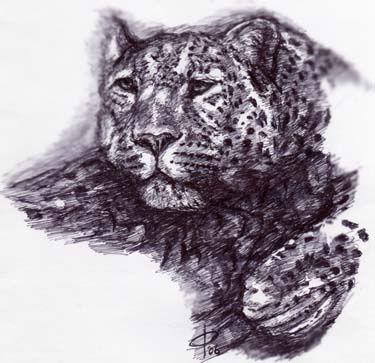
Wildlife Art: 'Lion'

In yet another wild burst of directionless creativity, I started yet another piece of artwork - this time as an ode to the Lions of Gir.

As usual I have been distracted with work halfway through, and have all good intentions of completing it... eventually.


BTW - when I finally get my act together, I'll be putting up an online gallery of some of my recent work - mainly just for amusement, but some will be for sale.

- Was that just a shameless plug?
- Heavens no, it was merely a tasteful announcement.
- Oh, that's alright then.

Conservation Frontliners: Iberian Lynx cubs born in captivity!

Two more Iberian Lynx cubs were born in captivity on March 23rd at 9:30pm to the same mother, Saliega, as last year's historic cubs - the first Iberian lynx to have ever been bred in captivity.

This is a truly wonderful achievement, considering the fact that the species is now recognized as the most endangered feline in the world.


The cubs were born at El Acebuche lynx breeding facilities in Doñana, Spain. So far the sex is unknown. It is possible that another of the five captive females (Esperanza and/or Adelfa) may be pregnant and may give birth in the next few days. This cannot be confirmed as the lynx workers take a hands-off approach. Both lynxes have put on weight but this may be a psychological pregnancy. The Acebuche centre is considered too small and this spring a second centre is to open in La Aliseda in Jaen which will take the new cubs and new captures.


Saliega and her new cubs


The latest lynx count by the Junta de Andalucia estimates that at the end of 2005 there were a minimum of 38 females with territories, a basic unit for counting lynx populations - as in a male's territory there can be one or several breeding females.
These female territories were divided between Sierra Morena (26) and Doñana (15), an increase of three over last years (all three in Sierra Morena), and the highest detected since 2001.

The minimum number of cubs confirmed (older than six months) is 36 (10 in Doñana and 26 in Sierra Morena.) The total population of the Iberian lynx, including this year's cubs is estimated at 169, up from 2001 with less than 140. The Sierra Morena population is now thought to be expanding, while Doñana is stagnant, though for the first time in three years a brood of lynxes have been born within the National Park's reserve proper, a sign perhaps that recently established rabbit pens are starting to work.


Captive-bred Lynxes are to be reintroduced in three new areas in the wild by 2009. It has also been announced that the cubs born in captivity are to be released in three initial areas: Sierra Norte (Sevilla) and Despeñaperros (Jaén) and Hornachuelos / Guadalmellato (Córdoba). The reintroduction will be carried out through “soft releases” in fenced areas of 15-20 hectares which will later be opened up.

Extremadura, Castilla-La Mancha and Portugal have been asked to determine possible areas for reintroduction over the next few years, Undoubtedly the role of the lynx as a flagship species will be a spur for conservation in all these areas.

Read more about the amazing work of the El Acebuche lynx breeding facility (and photos of last year's cubs!) at
Shadows and Light: Leopards, my discussion group on the Care2 network.

Friday, March 31, 2006

In the company of leopards

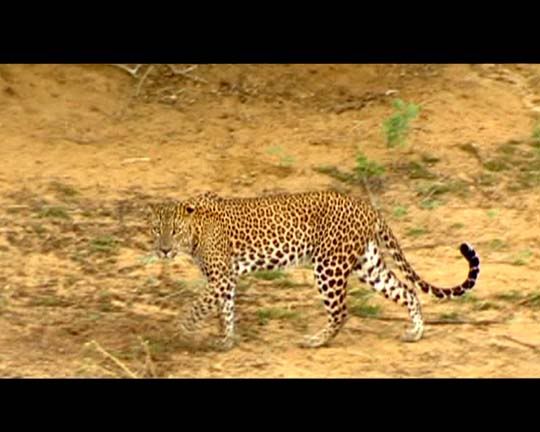
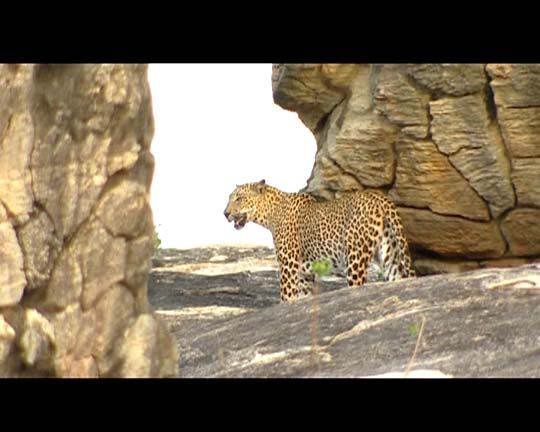
On the topic of big cats - here are a couple of leopard pics from my last field shoot in Sri Lanka.

They are both stills from footage I'm using for a documentary to be released at the end of this year.

The first is a beautiful young male - being very cautious as he approaches a waterhole just before dusk. He is watching a herd of Spotted Deer on the far side of the open ground!


The next fellow is a HUGE adult male keeping watch on his hilltop lookout. He had just chased away a female and her two 1 year-old cubs - probably his own offspring. This guy is about 7.5ft from nose to tail tip, and his head is massive! One of the largest Sri Lankan Leopards I have ever seen (but perhaps that's not saying much because I've seen less than twenty in the wild in my entire lifetime... so every sighting is a thrill).


These big cats never cease to amaze me with their grace, stealth and uncanny ability to disappear just as the camera focusses in on them...

A film-maker's nightmare, but a joy to experience in the wild.

Saturday, March 25, 2006

Panthera News: A good day indeed...

Not one, but two positive news reports about big cat conservation in Asia.

First, news about a subspecies I've had the great privilege to experience in life:

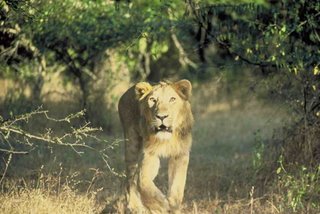
Asiatic Lions to get new Sanctuary at Jesar
Friday 24 March 2006

In a major step, the state government has decided to set up a new lion sanctuary at Jesar hills in the Bhavnagar-Amreli forests to ensure better conservation of the Asiatic lions of Gir.

The new location is on the eastern side of Gir sanctuary. A team of senior forest officials are in the process of demarcating 100 sq km area in the forest range of Bhavnagar and Amreli bordering Mitiala area.

A small wildlife sanctuary was created in Mitiala in 2004 following increasing congestion of wild animals in Gir. At present, more than 50 lions have made Mitiala and its surrounding areas their home. Once the new sanctuary comes up, it could provide a natural habitat to at least 100 lions.


The Gir sanctuary area has over 359 lions and 999 leopards at present. The state government decided on creating a new sanctuary after the alarming number of lion deaths - at least 100 in the last four years. Plus, continuous pressure from the Central government to shift the lion sanctuary to Madhya Pradesh for better conservation spurred the state authorities into action.

When contacted, state chief conservation of forest (wildlife) Pradeep Khanna admitted that the proposed new sanctuary would provide more space to the lions who have started coming out of the sanctuary area in search of new natural habitat. "We therefore decided to set up a new sanctuary for lions somewhere near Jesar," he said.

Well, obviously this has been a long time coming - they were talking about it over three years ago when I was filming in Gir. One wonders why it took the death of 100 lions to finally spur them into action. Losing just one or two individuals from this precious population should have been reason enough to set up the new sanctuary - inbreeding and a fragile gene pool being the main culprits for disease, cub mortality and weakened immune systems.

I recall they were also planning on demarcating a much larger sanctuary nearer the northern parts of Gujarat. Not sure about the progress of that - but Jesar is a start.

And now news about a species I've only dreamed of experiencing in the wild (sigh):

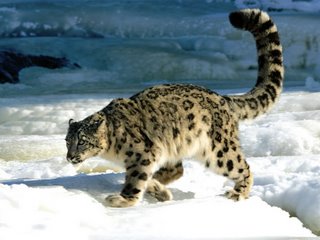
Villagers Encouraged To Protect Snow Leopards
Friday 24 March 2006

To impoverished residents of areas inhabited by snow leopards, protecting the animal may seem like an unaffordable luxury. But in Kyrgyzstan, some communities are deeply involved in a conservation program offering financial incentives to people who help snow leopards.

The habitat of snow leopards covers 12 countries - including Afghanistan, China, Kazakhstan, Kyrgyzstan, Russia, Tajikistan, and Uzbekistan.

Although the animal is legally protected throughout this area, only about 7,000 are thought to still survive in the wild. More than half of them are in China.


Snow leopards are killed for their fur and for their bones - which are used in traditional Asian medicine. They also are killed in retaliation for preying on livestock. Amankul Bikenov, from the Almaty Institute of Zoology in Kazakhstan, says that the animal also suffers because of the disappearance of its normal prey.

"In our territory there are only 250 to 300 snow leopards," Bikenov says. "What we do is try to locate and preserve them in special national parks. But despite these measures, their numbers are dwindling. It can be explained by the decrease of other species they use as food, such as Marco Polo sheep, wild goats, and others."

Almaz Musaev is the head of the hunting department at the Kyrgyz Environmental Protection and Forestry Agency. He says fewer than 300 snow leopards still survive in Kyrgyzstan. Musaev suggests a large-scale public awareness campaign is needed to help protect them.

"Our previous activities to protect the snow leopards have been insufficient," Musaev says. "Because there is a need to make every Kyrgyz citizen aware of the situation, we need to hold the leopards in high respect as the Indians deify the cow there. Without such actions, the work of our few staffers will fail."

Musaev also concedes that the issue cannot be resolved without the help of the international community.

At Akshiyrak and Engilchek, two villages In Kyrgyzstan's Issykkul region, a U.S.-based organization called the Snow Leopard Trust is trying to help people increase their household income in a way that also helps protect snow leopards and their habitat.

Together with local partners, the Snow Leopard Trust provides herders with training and equipment to produce handicrafts using wool from their livestock. These products are marketed at stores in the United States and through the Snow Leopard Trust's website.

In return, participating communities agree not to kill snow leopards or the wild animals that they eat. If even one person violates the contract, the entire community loses a cash bonus made available at the end of each year.

The Snow Leopard Trust's Tom McCarthy says that handicraft sales allow some families to nearly double their annual income - and that is without taking into account the bonuses.

"Their average annual income just from the handicraft sales is about $145," McCarthy says. "And they might only lose one or two livestock a year to snow leopards. They're very happy, then, not to kill those animals in exchange for keeping this handicraft project going."

McCarthy says the project model has been successful so far. He says his organization expects to expand the program to include other Kyrgyz villages later this year.

But he says it is sometimes difficult to measure the program's impact on the snow leopards' population.

In order to establish the current status of snow leopards and to determine where they live, the Snow Leopard Trust has helped fund a study in both Kyrgyzstan and China's Xinjiang region.

Scientists last year placed cameras with infrared detectors in the remote Tien Shan Mountains along the Kyrgyz-Chinese border. During several weeks, the cameras took 13 pictures of snow leopards on the Kyrgyz side of the mountains and 40 on the Chinese side. Samples of snow leopard faeces also were collected.

But Ma Ming of China's Xinjiang Institute of Ecology in the regional capital, Urumqi, says that its too early to determine the exact number of snow leopards there.

"In China we put the cameras in very good places and took many pictures," Ma said. "But this doesn't mean the Chinese population of snow leopards is big. It is too early. We must do research, we must continue the hard work."

The photographs are now being studied to see how many different leopards can be identified. Meanwhile, the faeces samples have been sent to genetic laboratories for analysis. Scientists hope the data will provide a better idea of how many snow leopards are still alive - and where they are living.