Friday, June 20, 2014

Field Journals: Borneo Turtles

 A few years ago I travelled with my crew to the shores of Sarawak, Borneo. Off the western coast we sailed to a wonderful chain of little islands collectively called the Talang-Satang Marine National Park.
 
I had travelled all this way for one reason - well a number of reasons actually - but the number one priority was to time our visit to coincide with the arrival of female green turtles, coming ashore to lay their eggs.

Now I've witnessed this incredible phenomenon before on the shores of Western Sri Lanka, and back then it was Olive Ridley turtles coming ashore en-masse. 


But the magic of this occasion was heightened by the location itself: a tiny, single-beached desert island with a tiny patch of forest; surrounded by a ring of shallow coral reef and crystal clear water - paradise!

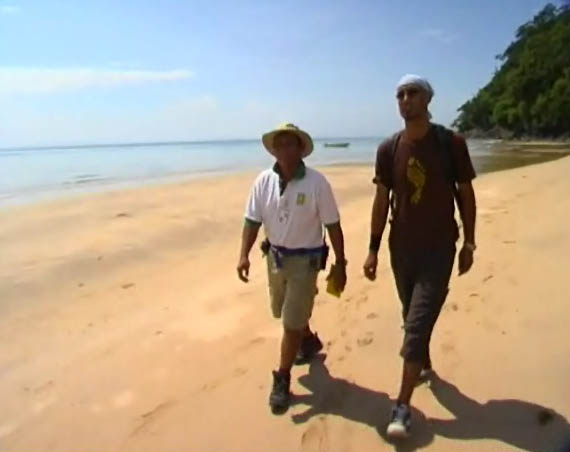
Christopher Kri and I explore
Sarawak's coastline
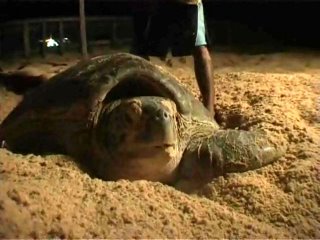

Fortunately our visit was timed almost to the last minute - the night we arrived, 7 turtles came ashore, and I was introduced to them by my guide, Christopher Kri, a local conservationist and all-round good bloke working for the Sarawak Forestry Board. Picture the scene: our tiny beach floodlit by a full moon; the waves sparkling under moonlight and not a sound from any of us, as we waited and waited.

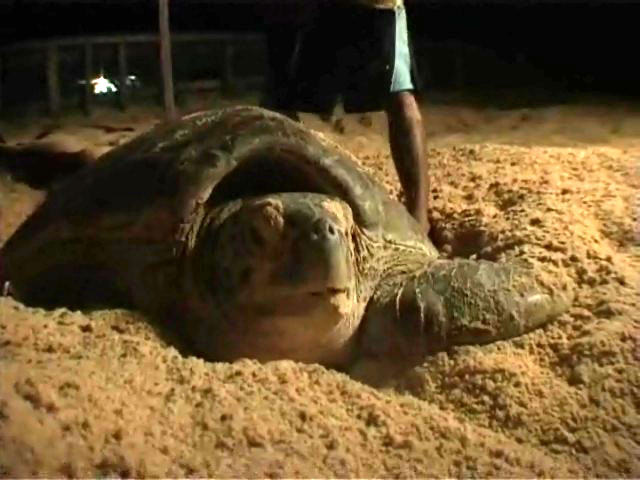
And then all of a sudden one of the rangers spots a dark hulk pulling itself out of the water and up onto the beach. At 3 o'clock in the morning, the Green Turtles had arrived.

Even though their progress on land was painfully slow and laboured, each turtle seemed to single-mindedly know where she was headed. Some traced their characteristic tractor-tread tracks directly to locations close to shore, whereas others meandered here and there all over the beach, spending the best part of two hours finding their desired spot. But sooner or later all seven settled down and started to dig their nests.
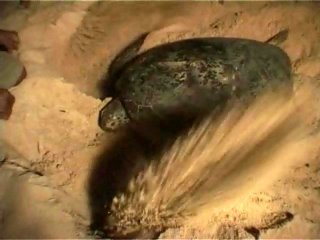

Turtles are easily disturbed during their ponderous movements along the beach. It doesn't take much for them to turn tail and head back to the safety of the water.

But once they settle and start their excavations, they go into an almost trance-like state, and its only then that the rangers come in for a closer inspection.


Its now that our friend Christopher comes into his own.

I seldom come across conservationists so deeply attached to their animal subjects, and Chris approaches each turtle with such reverence that you could almost imagine that he's welcoming back long-lost friends.

One turtle caught his attention in particular. Her tag number was 703/746 - but by the end of her long night, we were calling her Princess. Turns out that Princess is a repeat visitor - she has been returning to this island throughout her adult life to continue the cycle. Chris showed me the tag that had been attached to one of her front flippers all those years ago.
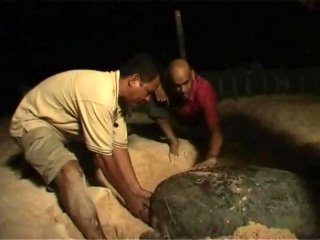


Chris introduces me to his beloved 'Princess'

After each of the turtles finished laying their clutch of eggs and burying this precious cargo under a cleverly concealed mound of sand, they retreated back to sea - hopefully to return in another 3 years.
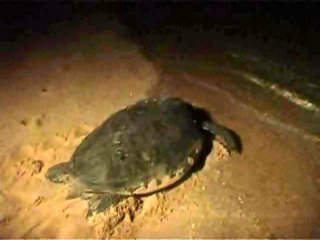

Because of the highly endangered status of the species in this part of the world, each nest is transferred, as soon as the female departs, to the safety of an enclosed hatchery, where the eggs are protected from predators and poachers. Around 58 days later, the babies hatch, and the forestry staff give them a personal escort back to the sea - in hopes that they will return here to lay the foundations for the next generation, some thirty years later...

Its always an incredible privilege to witness these events in the wild. Every time I have such encounters I always find myself wondering if it'll be the last time I get to see these wonderful animals on their own terms, in their own territory. I guess its a common fear shared by conservationists and wildlife-lovers alike. Still with people like Christopher Kri working incessantly to ensure the welfare of his turtle wards, I still live with these tenacious threads of hope, that the turtles at least will continue to endure, inspite of the decimation they have suffered at our own species' hands.


A short clip of my encounter with Christopher and his turtles...
 

Friday, May 09, 2014

Simple Minds, Sir David, and Sri Lankan Bears

(An old post (from 2006!), republished in celebration of Sir David's 86th birthday on the 8th of May)
 
Its amazing how a simple tune can evoke a vast store of nostalgia, seemingly from out of thin air.

This morning a song blaring from a distant radio, a typical tune from the mid-80's - I think it was an old hit by Simple Minds - tapped a totally forgotten region of my memory, and suddenly I was back in those old days of questionable hairstyles and garish clothes, surrounded by the sounds of the new romantics as the pop music movement called itself back then.

And there I was, a wonder-struck schoolkid in the heart of the Midlands in the UK, forgetting about my homework and my beloved BMX Chopper, and escaping instead into a world of meerkats and honeypot ants and mountain gorillas. A televised dreamland, made real by the unassuming magic of David Attenborough.
Life on Earth and the subsequent series in the Life trilogy were something of a revelation for me, a series that opened my eyes to the possibilities of the great unknown; that made me realize, even in my early teens, that there were corners of this world that I could never see, and yet there were some that I most certainly would. 

David Attenborough's calm and composed presentation struck home far stronger than any modern-day 'reptile hunter'; compelling me to think further than the shores of England, further than the physical constraints of the tired old elephants of London Zoo.
 

He made me realize that television could open the doors to the natural world; that TV could bring to life the reasons for environmental conservation in a far more compelling way than dusty old textbooks in dusty old classrooms. That TV could make nature accessible to anyone and everyone.

And so began a somewhat convoluted journey to where I am right now, with still miles to go. Whether I have made bad nature programmes or good, Sir David is directly responsible. I have always aspired to creating television in his approachable and accessible style. 


Even hard science can be translated for the least sophisticated audience, through a simple device called a story. Every story has a thread, that starts at the beginning, weaves the middle, and connects it all to the end.

 
Sir David: the milestone

I am learning how to tell a good story. I've even stepped in front of the camera a few times to try and bring life to the tale, but in all truth my aspirations of being an Attenborough are much like Golem aspiring to Gandalf - I don't have the white hair and I can't carry off the safari jacket.

But given enough maturing and the considerable weight of experience I may try again. Attenborough is still my milestone.

And so this leads me to my current project, one that began in mid '05 and is scheduled for completion later this year. Its a story that takes me back to Sri Lanka and into the heart of a country I have rediscovered with new eyes. It is also a story that Discovery Networks has taken considerable risks in commissioning, as its central character happens to be the island's most endangered mammal.

Numbering less than 300, Sri Lankan Sloth Bears are something of an enigma. They may as well be ghosts for most of the year, and I would be very surprised if even a quarter of the country's population knew of their existence.

And yet for just a couple of weeks they make themselves known, very briefly. It is this window of opportunity that my story hinges on... and perhaps the reason I often find myself shaking my head and asking a simple question to the world in general, "Why?"

I've had more than a fair share of luck during my years making wildlife shows, but what a way to start my debut with Animal Planet... forever waiting for that fountain of luck to run dry.

In truth however, nature has been kind to us. Inspite of unforseen forest fires and severe droughts, the bears did their disappearing/reappearing trick for us last year. It was still mostly a case of 'blink and you miss them', but when they did choose to oblige us - I can't begin to explain the feelings that raced through my bloodstream. A mixture perhaps, of immense relief, adrenaline and sheer awe.

Again I wanted to add that Attenborough ingredient into the body of the story, but as is often the case, I was reminded once again, that the world has moved on. The kids are more sophisticated, the audience has a limited attention span. The gentleness of 'once upon a time' has been lost in most of the work you'll see on Nat Geo or Discovery these days. Its not their fault, its what the public demands.
 

I feel a great sense of loss that the 'wonder of it all', the instinctive excitement of pushing aside a leaf and seeing what lies on the other side of the forest... all this will vanish when the David Attenboroughs of this world are no more.

I think sometimes that I was born two or three generations too late for this business. The marvel of wild discovery and exploration is taken for granted on our screens today. There are some gems that crop up amidst the rubble from time to time, but by and large this is the age of unnecessary risk-taking and showmanship and playing up to the camera, with the wilderness playing second fiddle. That should never be the case, and I wonder how long this genre of wildlife television can sustain itself.

So in many ways, the bear story has become a kind of visual 'holy grail' for me. Its important not just professionally, but also because it allows me the opportunity to tell a story about the island of my birth. Just one little story, a tiny fragment of a much larger and wonderfully complex picture - but a story that for once will have an audience that spans the world. This is something I had promised myself somewhat naively as an idealistic teenager.

If the bears do their part, I'm sure we can make something special together. And I'll be sure to put a little of the Attenborough ingredient in there somewhere, just to please that wonder-struck schoolkid, way back when.

Yes, its amazing how a simple tune can evoke such nostalgia...

Thursday, April 17, 2014

Born at the Right Time?

For those of you who know me well, I am forever lamenting the demise of the classic wildlife documentary. Those hour-long epics filmed on a grand scale, crossing continents within mere seconds to tell the story of an animal little heard of and barely ever seen before. 

Their stories were told with a moving narrative that described more than just their life histories, but evoked a sense of character and personality, and purpose.

Of course I am describing the legacy of Sir David Attenborough and the pioneering members of the BBC's Natural History Unit, who were instrumental in changing our perceptions and awareness of the natural world forever.


Their glory days were during the 80's when little explored corners of the world were suddenly brought to stunning Technicolor life on our TV screens. They must have been exciting times, encountering strange species and glorious landscapes for the first time - a total immersion into the wilderness.

And in those heady days of worlds-firsts and ground-breaking discoveries, the BBC were more than willing to put their money where their mouth was. Budgets were sky-high to accommodate long weeks spent in the jungles, and to equip crews with cutting edge and custom-made camera kits. Shoots were orchestrated on a grand scale - but the final results always justified the considerable investments that were made to produce such films.

Those were the golden days. Things have changed considerably in the three decades that have followed. And when I finally found myself in a position where I felt I had the skill sets and experience to undertake my own natural history epic - I discovered that I was too late...

The world has changed, people's expectations have changed. The TV industry itself has changed. We are now part of a fast food society that digests everything feverishly and furiously, and wildlife documentaries are no exception to the rule. I've been told that audiences no longer have the attention span to sit through a natural history film that gradually unwinds through the course of 60 minutes; that stunning panoramas no longer captivate - now regarded as nothing more than so many minutes of televisual wallpaper. We have become blasé about the things that once stopped us in our stride and sent shivers down our spine.

Where has our collective sense of wonder gone? Speaking as an individual, I still get goosebumps when I see a finely crafted piece of TV or film. Music also does that to me - often. I've spend sleepless nights trying to figure out how to imbue some of that essence into my own productions - whatever the creative medium may be. I even find my days haunted by a great piece of narrative or a clever and insightful tagline. Such distractions have always tended to get in the way of all my other daily priorities - but I wouldn't have it any other way. And I know I am not the only one.


There are so many of us that still retain wonder within ourselves. Those of us who remain addicted to the creative process - to the things that make our hairs stand on end. Surely we are not in the minority? Surely we are not alienated to the millions out there who we create our products for? It confuses me. It exasperates me. It has made me question my own creative decisions.

Sometimes I come to this conclusion - I should have been born much earlier, and started my career in the 80's. When things were still so new, when technology and individual expression and risk-taking were just starting to bear fruit on the TV screen. Those would have been the real Wonder Years.

But then again, I catch myself in the midst of my melancholy, and set myself straight... Perhaps I am in this business at the right time...

Complacency, tedium and carbon-copy television may rule the airways - for now. But then I guess that's where a new way of thinking has to come in - to approach the obstacle from a different point of view - to catch an audience before they even know they've been caught. To make 'em think once more, to give them back their child's eye...


The Tuskerman's time in the field may be coming to an end, but I can now take control of the driver's seat and steer a new generation of TV-makers - in the right direction...

And suddenly, perhaps this challenge will be worth the effort after all...

Tuesday, April 15, 2014

The Mountains of the Moon...

That's what it felt like - to be standing on a landscape, so spellbinding, and yet so alien - that it almost felt unreal to actually be there.


The steppes of Mongolia spread out like some vast cloak of grey and green over a gently undulating terrain. It seems almost too tidy, too well planned out - compact stands of pine trees cresting every mountain-top. Boulder-strewn riverbeds twist, serpentine, across the valley floors. Closely cropped pastures of grass cling to the ground - everything is in its right place, even the wildflowers grow in a pleasing kaleidoscope of colours.


Its the vastness of the place that gets to you though - you feel insignificant in the scheme of things, as your jeep struggles along a dirt track riddled with potholes. The sheer scarcity of people hits home, as you survey the horizon, and over a distance of say, twenty kilometres or so, only two or three homesteads lie huddled together, with a small herd of livestock scattered nearby. The characteristic yak-skin tents known as Gers are all that these people of the plains have to protect themselves from the elements. We are here during summer and there's already a chill in the air. But when winter hits, it does so with a vengeance - as temperatures fall below zero and the entire country becomes frozen beneath snow and ice.


Yes it is beautiful, but it is a lonely kind of beauty. Even for someone like me who is happy to escape from the boundaries of human society from time to time - this vastness could well become overbearing after a while. Its no wonder the Mongol people seek out each others' company in annual festivals and fairs. A sense of Community is a survival strategy in a place like this, where you could easily lose yourself in a constant landscape that stretches further than the eye can see and the mind can comprehend...

They are tough, these people - sturdy, enduring and tireless in the undertaking of their daily chores. As most of them are herders, horses take centre-stage in their lives. These wiry steeds are almost like living extensions of their riders. They move imperceptibly together across the plains in an ageless scene that could be centuries old. The Horse and the Rider - defining symbols of Mongolia.


We spent a precious few days in their company, and it wasn't long before all my sense of bravado about being able to live this kind of life, flew out of the window. They live right off the land, quite literally. And despite best-laid plans, every day is determined by the elements themselves. Only forward-planning gives these people a fighting chance, plus the ability to react fast to any given situation, be it positive or negative.

"Expect the unexpected" is an unspoken mantra, and the Mongolians' approach to life is to grab it by the throat and hold on for the ride.
Yes it is a beautiful life. But a life that they have to work hard for. The blood of the Khans certainly endures out here, in the vast empty plains...


Thursday, April 10, 2014

Fisherman's Moon

I have sailed the inbound sea. I have led a nomad's life, wandering with the great shoals; sleeping under Orion's light, singing the liquid song of my loss and my regret. For the sake of my brothers, I keep my mind from wandering to that dying horizon, where my lover awaits with the comfort of dusk.


The dunes afford no future. For my brothers and I are fishers of the sea. We have turned our blistered backs from the lie of the land. Far from the delicate embrace of women. Denied the saving grace of a child's cry. But we are sons of the sea. Children of the sand. And the ocean calls our name.


My possessions are few. A driftwood hut to shelter from the sky. A clay pot to cook my daily meal of rice and fish. A covering cloth to protect me from the fevers of morning and midday. And the tools of my trade. The cloaking net to imprison. The rusting knife to impair.

I entertain the cavorting egrets and the whispering winds. Dune water refreshes me, and saltwater goads my skin. But the pulse is strong within our hearts. From dusk until dawn, we will fight the sea. Until the waves surrender, and she delivers her bounty into our weathered hands. And we will grow old with our struggles. The sea will bend our backs. Broken like the great heads of the reef. Eroded like the jewelled cliffs of the abyss. As the waters recede and the debris of the ravaged sea washes in with the tide - there we will be, like so many empty shells and lost coral memories.


But now the tide favours us. And we set sail towards the night. I cast my net in this dreaming ocean, feeling the cool brine washing my dark hands; watching the fisherman's moon rise over me.


(In remembrance of Sri Lanka's southern coast fishermen, whom I spent some memorable days with, many moons ago...)


Wednesday, April 09, 2014

Magic In The Wilderness

It never ceases to amaze me how Nature continues to weave Her magic disappearing spells on us, even in this age of mass deforestation and urbanization.

As species go extinct as fast as the seconds hand on a clock, so too do others seemingly disappear and then suddenly re-appear like some monumental game of hide and seek.

A recent case in point is the beautifully enigmatic Borneo Bay Cat (Pardofelis badia). Although first identified 138 years ago, almost nothing is actually known about it. In fact the cat has managed to completely elude researchers and conservationists. The first photo of the cat wasn’t taken until 1998 and the first video was shot just two years ago, but that's about it - nothing is still known about its life cycle or behaviour.

You know, scientists dream as feverishly and as frequently as the rest of humanity, and someone's dream obviously came true when this gorgeous red and brown creature recently wandered through their camera trap!


Photo by Jo Ross and Andrew Hearn/Global Canopy Programme

It disappeared just as soon as it appeared, but it was enough to rekindle that spark of enthusiasm that draws us back to the wild, time and time again.

Who knows when it will be seen again; who can predict when it performs its next magic trick? But just the very knowledge that something as sizable and as stunning as the Borneo Bay Cat can continue to elude us even in this ever-shrinking world; now that's a good feeling...

Thursday, November 14, 2013

In Remembrance of Cocoa

Our precious Cocoa, whom we fostered and then adopted over 11 years ago had to be put down recently (9th November 2013) as her cancer had spread and she was in pain. 

She was diagnosed with cancer in September this year (a lump on her front paw which bled profusely) and succumbed to the disease in November. We knew that the cancer was aggressive and we would lose her, but we did not expect it to be so fast.

She was the most amazing child that we ever had the honour of knowing and we miss her tremendously. Thank you God for entrusting her to us; she was the light of our lives.


Tuesday, March 19, 2013

LIFE LESS ORDINARY

I love telling personal stories; about how people are able to change themselves and the world around them. People who make an impact for the better...

Not only are they inspirational to me, but their work has a contagious effect that you can't help yourself being drawn towards...

I was asked to take part in the production of a series called Life Less Ordinary for Channel NewsAsia, and it was my particular pleasure to tell the story of Kiran Sethi - a game-changer in more ways than one!

Watch the full episode:

BOOMTOWN ASIA

It's been a busy New Year, and I have been hard at work on several programmes for Channel NewsAsia.

The station is really diversifying and spreading its reach across Asia and beyond, and so has provided some interesting opportunities in terms of subject matter and storytelling.

I just recently finished series-producing and co-writing a technology series for CNA, entitled Boomtown Asia; a local take on the ever-popular Megastructures series...

We were able to employ some cool graphics to create a glimpse of the future:

Watch the full first episode here:

Monday, January 16, 2012

Tuskerman Transmissions #02

ARMPIT ALARM

I learned today, that the Silverback male Gorilla will emit a strong body odour from his armpits when he is either threatened or excited, and to also notify other gorillas of his location.

Of the 98.67% genetic similarities we share with this gentle giant, it figures that armpit odour had to be somewhere on the list...

So if you are ever fortunate enough to encounter one of our closest cousins in the wild, don't bring deodorant...

Sunday, January 15, 2012

Tuskerman Transmissions #01

BEATING THE QUEUE: ATTENBOROUGH-STYLE

While stuck in an hour-long queue at the supermarket, (for example, on the last weekend before Chinese New Year), why not pass the time by pretending to be David Attenborough, and narrate a wildlife documentary in your head, using the people around you as your subjects/characters.

It is extremely entertaining, and becomes a fascinating expose of human behaviour, as you begin to identify family traits and the various subtle interplays of domination and submission within our strange society.

And hey presto... one hour has elapsed, the queue has disappeared, the smelly children have gone, and you at the checkout. Nice.

Tuskerman Transmissions: A New Year...

Over the years I have realized just how much anecdotal and useful bits of information I have come across on a daily basis - only to have them lost in the vacant recesses of my brain, to be lost for all eternity.

So this year, I shall endeavour to preserve them for posterity, here on the pages of this blog, so that others might find them of use, or at least a desperate talking point after dinner... And you never know, they just might help save your life...

So without further ado, welcome to the Tuskerman Transmissions...

Tuesday, May 03, 2011

Saturday, October 30, 2010

Charith Pelpola - One Life Photos

After having had such an incredible experience filming in Mongolia earlier this year, I thought it might be a good idea to submit a few of my photos to this ONE LIFE photography competition.


Have a look through my little portfolio, and vote if you have the time!

Thanks!

Charith Pelpola - One Life Photos

Wednesday, September 29, 2010

SAVAGE SPORTS - the end!

For the final episode in the series we pull out all the stops - bringing you a sport that has never been filmed before, from one of the most remote corners of Indonesia.

The aim of Mbela is to draw blood - it is violent and sometimes brutal and if you are born into the community where it originates - you MUST play the game...


A big thank you to all our viewers, friends, and you wonderful people out there who helped put this project together and make it a reality.

Channel NewsAsia will be repeating SAVAGE SPORTS so if you missed out on any of the episodes, you can catch them again. If you have any comments, please do share them on the CNA forum.

Thursday, August 12, 2010

Presenting: SAVAGE SPORTS

After months of stops and starts and cutting through red tape and a maze of filming permits, Firewalker's inaugural TV production SAVAGE SPORTS, is off the ground.

Airing this Sunday in Singapore and across the region, producing the series really has been a trial by fire, but nevertheless a rewarding experience thus far.

Check out the show's opening titles for a flavour of what to expect in the series:


For more information, or if you'd like to join the fan page for more info and behind-the-scenes snippets, visit our FACEBOOK page:


http://www.facebook.com/savagesports

Sunday, April 18, 2010

Beginnings: "Project Olympic"

After half a year of researching and reshaping - Firewalker Productions has been commissioned by Channel NewsAsia to produce a 6-part documentary series about traditional sports throughout the Asia Pacific region.

As we cannot reveal the true name of the series just yet, it is for the moment code-named - Project: Olympic.

Field production starts in earnest in May 2010. Charith will be directing and writing.

Kristen will be intimidating people whenever necessary...


Thursday, February 18, 2010

UNEXPECTED ACCESS: On the Poacher's Trail...

I don't normally self-advertise but for those of you who are able - Watch UNEXPECTED ACCESS tonight on Channel 5 at 10pm please!

A rare opportunity for me to highlight the problem of the illegal wildlife trade to a prime-time audience. Hope many will tune in; especially poignant in this Year of the Tiger... animal lovers beware - some disturbing images - but these things must be highlighted from time to time...

The story highlights the efforts of the 30-strong team of Forest Rangers from Thailand's Thap Lan National Park - over 22,000 square kilometres in size - and their continuing fight against an onslaught of illegal wildlife poachers...

Highlighted in the episode is a huge confiscated haul of adult tiger carcasses and leopards and sun bears from a recent operation in late 2009. Shocking to see the results of the wholesale butchery and slaughter thats going on even as we speak...

Thursday, November 05, 2009

FIELD JOURNALS: The Philippine Eagle

There is a bird that haunts the remaining forest mountainsides of the Philippine island of Mindanao. People know it by various names; scientists christened it Pithecophaga - The Monkey-Eater; but the locals know it by another name: Haring Ibon - The King of Birds. 
Standing 1-metre tall and weighing over 6kg, the Philippine Eagle is described as being the most regal, tallest, and perhaps largest raptor in the world. It is said to have the longest wingspan amongst all other eagles - measuring over 2 metres. It is also one, if not the rarest and most endangered bird of prey in existence.
History recounts that this fiercely territorial bird may never have been common over the 4 islands it has been reported to inhabit. Breeding pairs mate for life, and require a territory of 100km2 to support themselves. For over 30 years there have been strong predictions of the Philippine Eagle’s impending extinction. In the mid-60's the bird was regarded as "definitely on the road to extinction", an event predicted to occur within the following 25 years. This together with an escalating rate of deforestation, and the birds only producing a single egg every two years, the fate of the eagle was apparently sealed.
But today the Philippine Eagle still survives. After the initial warnings by conservationists, more studies were undertaken, and eventually, the Philippine Eagle Foundation (PEF) was formed, dedicated to the cause of conserving this national bird. The foundation operates from Davao, and is kept going by members’ contributions, and by grants from international and local sources. The PEF is managed by a group, fast gaining a reputation for their dogged determination to see the eagles' population increase and multiply.
A few years ago, I undertook a project to document the work of this resilient Foundation – featuring, at the heart of their conservation project – a single white 200g egg, cradled in the sterile confines of an incubator. After years of trials and tribulation, successes and heart-breaking failure – the culmination of all the foundation’s work had come to rest on this one egg.

The eighth to be hatched in their pioneering captive breeding project, the fate of the hatchling that emerged from this egg would be considerably different from its predecessors, who are now part of the foundation's captive bred population. Because, within a year of its birth, this eagle would be paired with a mate and released back into the wild.

This was to be the first ever attempted reintroduction, and the path to success would be laid with many challenges. Philippine Eagles are notoriously difficult to keep in captivity; with infection and physical ailments looming every step of the way. And then of course, the eaglets would have to be re-taught the instincts that they had lost in captivity. Doming Tadena, deputy director of the captive breeding operation, and surrogate father to all of these isolated babies, will teach his ‘children’ to become increasingly detached to people, encouraging them to cultivate their wild distrust of humans. From the time of its birth the eaglet will have no direct contact with humans, and even during feeding time, it will only see the face of its surrogate mother, a hand puppet of an adult eagle.


Dennis Salvador, executive director of the Foundation, would also have to shift his campaigning work into a higher gear. In preparing the eagles for the wild, he must work closely with the communities in the uplands of Mindanao, providing them with the impetus to undertake their own local forest conservation. The Foundation encourages these slash and burn farmers to switch from their destructive habits, to more stable methods of agriculture – a process as important as the groundbreaking captive breeding work, because without the forests, the eagles lose their habitats - and that's a sure way of losing them forever.

Ultimately the day came when, Kabayan, the chick born in November 2002, was released back to the wild on Earth Day, April 22nd 2004.
Settling into the forests of the country's highest peak, the juvenile eagle was observed to be practicing his hunting skills constantly, performing mock attacks on sticks and branches and occasionally attempting to hunt for small prey items like lizards and rats. He was reported to have been interested in a pack of monkeys but failed in his pursuit as they scurried for cover in the trees.

All was looking well for this pioneering eagle, but just a year later, and he was dead - accidentally electrocuted as he perched on a live electricity pylon.
All that effort, all that hope - lost in a moment's miscalculation...
But the true success of this project lies not in the release of this single bird, but in the lessons learned from its brief return to the wild, and the exploits of its successors, and hopefully their eventual offspring – born, raised, and soaring free in the wild.
Only then will the Philippine Eagle Foundation raise their hands in victory. But until then, the fate of this King of Raptors remains one of the most important species-conservation issues on the planet.

Wednesday, June 24, 2009

FULL VIDEO: Season of the Spirit Bear

Just a quick note to let you all know that I have uploaded the entire Spirit Bear documentary onto YouTube.

Because of the site's requirements, I had to divide the show up into smaller bite-sized peices, six parts in all.

But if you click on this playlist, you can watch the entire documentary uninterrupted:


Enjoy!

Cheers,
Charith