I knew I shouldn't have done it as soon as I walked into the place...
Stepped into the pet shop to buy the furry ones their food, and I was hopelessly, magnetically drawn to this beautiful creature seated quietly amid the noise and excitement of the puppy sales area at the back of the store.
I feel sorry for Huskies raised in Singapore - bred to brave the winters of the Northern Hemisphere, it must be uncomfortable being slow-baked in equatorial Singapore...
But this little fellow had such a look in his face, such a clever spark in his cool blue eyes, that I was tempted to just whisk him out of there... Cocoa would have been a happy little girl too - he is a handsome little devil...
Sigh... oh well, I hope he gets a good home - so many dogs in this country are bought on a whim and then discarded when the thrill rubs off. I wish him well.

Thursday, September 20, 2007
Saturday, September 15, 2007
Shop of Horrors
I am not often confronted by things which leave me at a loss for words, sickened and saddened at the same time.
But today during a casual wander through Singapore's shopping district, I came face to face with such an abundance of apparel and high fashion made from animal fur, that for a moment it felt that I had been transported into some kind of glorified slaughterhouse.

Name any top fashion label and I can tell you that almost all of them were stocking at least one piece of clothing made from, or adorned with fur. And we are supposed to living in an age of enlightenment...
 It saddens me that wherever we went, there were hordes of young things fussing over these horrific creations. I tried to imagine if even the slightest shadow of doubt lingered somewhere in one of these impressionable minds - but this didn't seem very likely.
I don't want to sound preachy, but surely we've been through the whole fur issue time and time again. There have been countless campaigns, inumerable protests, several shocking ad campaigns - so what else does it take to open people's eyes?
This is not the Age of Enlightment, this is clearly the Age of Ignorance - and remembering the looks on those adoring faces, its seems that Ignorance is Bliss...

But today during a casual wander through Singapore's shopping district, I came face to face with such an abundance of apparel and high fashion made from animal fur, that for a moment it felt that I had been transported into some kind of glorified slaughterhouse.

Name any top fashion label and I can tell you that almost all of them were stocking at least one piece of clothing made from, or adorned with fur. And we are supposed to living in an age of enlightenment...
 It saddens me that wherever we went, there were hordes of young things fussing over these horrific creations. I tried to imagine if even the slightest shadow of doubt lingered somewhere in one of these impressionable minds - but this didn't seem very likely.
I don't want to sound preachy, but surely we've been through the whole fur issue time and time again. There have been countless campaigns, inumerable protests, several shocking ad campaigns - so what else does it take to open people's eyes?
This is not the Age of Enlightment, this is clearly the Age of Ignorance - and remembering the looks on those adoring faces, its seems that Ignorance is Bliss...

Saturday, July 21, 2007
How to Disturb the Dog
Now that she is 5 months old, Pumpkin, our resident cute kitten and Twinkie's pride and joy, has learned how she can get away with things that other animals in our household cannot.

Take Cocoa's tail for instance - many others would love to - but its seriously out of bounds. Cocoa does not like her tail being tampered with. But now Pumpkin has shattered that taboo completely, and Cocoa is at a loss - her brain is still telling her that this adorable little kitten is vulnerable and innocent and so should therefore not be physically harmed.
It will take a while before Cocoa's brain finally realizes the truth about Pumpkin, and until then, this little kitten plans to take full advantage of the situation.
Just check out Cocoa's hopeless, pleading expression...

Take Cocoa's tail for instance - many others would love to - but its seriously out of bounds. Cocoa does not like her tail being tampered with. But now Pumpkin has shattered that taboo completely, and Cocoa is at a loss - her brain is still telling her that this adorable little kitten is vulnerable and innocent and so should therefore not be physically harmed.
It will take a while before Cocoa's brain finally realizes the truth about Pumpkin, and until then, this little kitten plans to take full advantage of the situation.
Just check out Cocoa's hopeless, pleading expression...
Thursday, July 19, 2007
I knew it, I just knew it...
Far from me to be a foreteller of doom and gloom, but I have to say that last year, when we were wrapping up our final weeks of filming in the glorious wilderness of Wasgamuwa National Park in central Sri Lanka, amid that slightly weightless feeling of being completely at peace with your surroundings, I commented, "this is too good to be true."

On our search for evasive Sloth Bears, we had witnessed the hand of Man wreaking havoc on part of the reserve, when a slash-and-burn fire from a farm on the park's boundaries had blown out of control and rendered huge swathes of the park into a lifeless, blackened wasteland. Of course the Earth eventually heals herself, as she did after the fire, but today I fear the outcome will be very different...
I've just heard from my uncle over in Sri Lanka, who is actively involved in wildlife conservation, that the government has given the go ahead to build a dam within Wasgamuwa, and along with it, will be installing a hundred or so families in the vicinity. I dread to think what is to follow. The repercussions for the wildlife will be devastating. The park already exists on a fine balance - throw in a bunch of humans and lets see what happens.
From what I understand the plan has yet to be implemented, and a campaign organized by wildlife enthusiasts and conservationists is about to ensue. More news as it follows.
I once half-joked to someone regarding my Sloth Bear documentary, that I hoped it would never become an epitaph for something that was now lost to the country - and that included the animals and their habitat.
Nothing to laugh about now.


Wasgamuwa - as it was when we were there

On our search for evasive Sloth Bears, we had witnessed the hand of Man wreaking havoc on part of the reserve, when a slash-and-burn fire from a farm on the park's boundaries had blown out of control and rendered huge swathes of the park into a lifeless, blackened wasteland. Of course the Earth eventually heals herself, as she did after the fire, but today I fear the outcome will be very different...
I've just heard from my uncle over in Sri Lanka, who is actively involved in wildlife conservation, that the government has given the go ahead to build a dam within Wasgamuwa, and along with it, will be installing a hundred or so families in the vicinity. I dread to think what is to follow. The repercussions for the wildlife will be devastating. The park already exists on a fine balance - throw in a bunch of humans and lets see what happens.
From what I understand the plan has yet to be implemented, and a campaign organized by wildlife enthusiasts and conservationists is about to ensue. More news as it follows.
I once half-joked to someone regarding my Sloth Bear documentary, that I hoped it would never become an epitaph for something that was now lost to the country - and that included the animals and their habitat.
Nothing to laugh about now.


Wasgamuwa - as it was when we were there
Wednesday, July 18, 2007
VIDEO: Battle to Save the Tiger
Found uploaded by someone else on Google Video - the full 49 min documentary. Watch it while it remains online. You can also download it and watch it with Google Video Player.
The Indian Tiger is in deep trouble. Thirty years ago India set aside over 30 tiger reserves controlled by Project Tiger. Initially it was hailed as a great success, but in the last few years hundreds of tigers have been poached from under officials' noses according to WPSI (Wildlife Protection Society of India) run by Belinda Wright. This film, narrated by Sir David Attenborough, looks at the controversy surrounding the plight of the tiger. Can they come back from the brink of extinction again?
The Indian Tiger is in deep trouble. Thirty years ago India set aside over 30 tiger reserves controlled by Project Tiger. Initially it was hailed as a great success, but in the last few years hundreds of tigers have been poached from under officials' noses according to WPSI (Wildlife Protection Society of India) run by Belinda Wright. This film, narrated by Sir David Attenborough, looks at the controversy surrounding the plight of the tiger. Can they come back from the brink of extinction again?
Live Health and LIVE EARTH
My apologies for such a long absence. It has been an interesting time, where I've taken the opportunity to explore the hidden depths of hospitals and experience some of the most interesting observational procedures. Nothing life-threatening, just a few probes and scopes and scans just to figure out how my erratic transplanted kidney is faring.
To all intents and purposes it has shut down for good, but its still physically stable, so not at risk from infection, which is a relief, because that scenario would have led to more medical fun and games. After several visits along the long white corridors, I was finally introduced to the CT Scan machine - a wonderfully futuristic device that section by section, recorded a 3D image of my internal structures. Quite fascinating really, apart from the slight discomfort of having to be injected with some kind of fluorescent red dye.
Anyway all this probing has revealed nothing out of the ordinary, and that's good to know - so I am back to work on various projects and functioning as per normal.
I've given the blog a bit of a spring-cleaning, and although its not completely ready yet, and yes indeed it may seem a bit childish - I thought it would be nice to inject a bit of colour into the scheme of things. Let's see how long it takes for Charith to get bored with this look...
Anyway, in terms of all things green and environmentally friendly, I tuned into LIVE EARTH last week, and dutifully wore green over the weekend to show my support. I then watched as much of the concerts as I could, and then waited for global impact to take place like the proverbial shockwaves from an earthquake. Of course those ever expanding ripples of awareness never really took shape. I am old enough to remember the Live Aid concerts and the Amnesty International concerts before that, and the incredible impact they had on audiences across the world - it wasn't just the music, but it was the messages that the musicians were actively conveying on stage that really hit home.
Live Earth seemed far more of a passive affair from what I experienced - most performers just did their sets and left the stage without so much as a word of green advice to their adoring audiences. A wasted opportunity.
And then of course there was the strange paradox of an event celebrating environmental-friendliness, while over 100 popstars jetted around the world, using vast amounts of power to light up their shows and pump up their amplifiers. Of course a true green, carbon-neutral, eco-friendly music concert would have been the popstars performing unplugged to small intimate audiences in pubs and clubs across the world, without any spectacular lightshows and no big sound systems.
But would that make good TV? Of course not.
And anyway, an eco-friendly music extravaganza is sorely lacking if Bono and U2 are not involved. Did anyone else notice their strange absence? This should have been right up their moral alleyway...
Linkin Park were good though
To all intents and purposes it has shut down for good, but its still physically stable, so not at risk from infection, which is a relief, because that scenario would have led to more medical fun and games. After several visits along the long white corridors, I was finally introduced to the CT Scan machine - a wonderfully futuristic device that section by section, recorded a 3D image of my internal structures. Quite fascinating really, apart from the slight discomfort of having to be injected with some kind of fluorescent red dye.
Anyway all this probing has revealed nothing out of the ordinary, and that's good to know - so I am back to work on various projects and functioning as per normal.
I've given the blog a bit of a spring-cleaning, and although its not completely ready yet, and yes indeed it may seem a bit childish - I thought it would be nice to inject a bit of colour into the scheme of things. Let's see how long it takes for Charith to get bored with this look...
Anyway, in terms of all things green and environmentally friendly, I tuned into LIVE EARTH last week, and dutifully wore green over the weekend to show my support. I then watched as much of the concerts as I could, and then waited for global impact to take place like the proverbial shockwaves from an earthquake. Of course those ever expanding ripples of awareness never really took shape. I am old enough to remember the Live Aid concerts and the Amnesty International concerts before that, and the incredible impact they had on audiences across the world - it wasn't just the music, but it was the messages that the musicians were actively conveying on stage that really hit home.
Live Earth seemed far more of a passive affair from what I experienced - most performers just did their sets and left the stage without so much as a word of green advice to their adoring audiences. A wasted opportunity.
And then of course there was the strange paradox of an event celebrating environmental-friendliness, while over 100 popstars jetted around the world, using vast amounts of power to light up their shows and pump up their amplifiers. Of course a true green, carbon-neutral, eco-friendly music concert would have been the popstars performing unplugged to small intimate audiences in pubs and clubs across the world, without any spectacular lightshows and no big sound systems.
But would that make good TV? Of course not.
And anyway, an eco-friendly music extravaganza is sorely lacking if Bono and U2 are not involved. Did anyone else notice their strange absence? This should have been right up their moral alleyway...
Linkin Park were good though
Thursday, March 15, 2007
cuteness - a dangerous trait
Well the kittens are now five weeks old. They seem to have already developed some personality, having discovered early on the many advantages of being cute, small and furry and therefore entirely and instantly forgiven for any misdemeanor.
Having learned to climb before they could walk, they have established the sofa as their new domain. Here they are captured in a brief moment of rest - that's the youngest, No.2, who is still deciding if she is either Noodles or Peanut - she is probably meditating here on the merits of both names...
No.1, or Pumpkin is the psycho attacking her own shadow at the back. No.3, who is not pictured, is Lemony, and is probably off somewhere scaring one of the dogs...
As you might have guessed, we don't spend a great deal of time mulling over names for the kids - they just make themselves known somehow. For some mysterious reason, almost all of our furry ones are named after items of food. Some kind of subliminal message there perhaps...
Having learned to climb before they could walk, they have established the sofa as their new domain. Here they are captured in a brief moment of rest - that's the youngest, No.2, who is still deciding if she is either Noodles or Peanut - she is probably meditating here on the merits of both names...
No.1, or Pumpkin is the psycho attacking her own shadow at the back. No.3, who is not pictured, is Lemony, and is probably off somewhere scaring one of the dogs...
As you might have guessed, we don't spend a great deal of time mulling over names for the kids - they just make themselves known somehow. For some mysterious reason, almost all of our furry ones are named after items of food. Some kind of subliminal message there perhaps...
No accounting for Good Taste
Well alright! "Spirit Bear" has been nominated for an award at the Wildlife Asia Film Festival, currently happening here in Singapore.
It has been shortlisted for the "Best Director who is bald and very tall" category - a hotly contested award as you might expect... And if for some reason I'm not victorious there, it's also been entered into the "Best Local Production" category, which is a bit more nerve-wracking, as the other entries are very good indeed.
Well, I've always wanted to be nominated for something, so if that's as good as its going to get, then a nomination is just fine with me.
Until the next time, of course...
(Those old Sloth Bears have been good to me)
It has been shortlisted for the "Best Director who is bald and very tall" category - a hotly contested award as you might expect... And if for some reason I'm not victorious there, it's also been entered into the "Best Local Production" category, which is a bit more nerve-wracking, as the other entries are very good indeed.
Well, I've always wanted to be nominated for something, so if that's as good as its going to get, then a nomination is just fine with me.
Until the next time, of course...
(Those old Sloth Bears have been good to me)


Wednesday, February 28, 2007
King Ape
 Last year, new genetic tests comparing DNA from humans, chimps, gorillas and orangutans revealed striking similarities in the way chimps and humans evolve - which set them apart from the others.
The finding added further weight to a controversial proposal to scrap the long-used chimp genus Pan and reclassify the animals as members of the human family.
The move would give chimps a new place in creation's pecking order alongside humans, the only survivor of the genus Homo.
And now more fuel to the fire - the discovery of a tribe of chimpanzees in Senegal, Africa, that have been observed fashioning and then using wooden spears to hunt smaller primates...
"Researchers documented 22 cases of chimps fashioning tools to jab at smaller primates sheltering in cavities of hollow branches or tree trunks ... witnessed a chimpanzee extract a bushbaby with a spear."

This is a fascinating and yet disturbing new discovery. One wonders if the boundaries between chimps and humans are now just a matter of a few facial expressions and an upright backbone. They may not speak like we do, but just look at the list of similarities that we share with our ape cousins. They've already been documented hunting smaller monkeys, committing genocide and even torturing.
Many experts believe because of our own human impact on the Earth, that chimpanzees have reached the end of their evolutionary journey - but given these traits, and another million years or so, and of course taking us out of the equation, I am sure that chimps would go on to fill our shoes quite comfortably.
Theoretically it was only a million years or so in the past when one tribe of apes, outmaneuvered and out-competed by a dominant forest-dwelling chimpanzee ancestor, was forced to take to the open plains in search of new territory and stride out on their hind limbs...
The chimps were always Kings of the Forest, perfectly adapted to the more rigorous demands of surviving in this complex environment. I'm sure that there'll be further secrets to their success revealed in the years to come...
Thursday, February 15, 2007
In the family way...
I guess the time finally comes to everyone, when they must assume the reigns of responsibility.. and guide a new soul into this world. Well ladies and gentlemen, that time has finally caught up with me... I have become a grandfather.
 Twinky has given birth to 3 kittens, amidst much panic and nervousness and commotion (coming mostly from Kristen and myself).
So this past week I have focussed my attention on the animal life that lives in my house...
Having never witnessed a cat giving birth before, it was a fascinating experience - and had its fair share of drama, as it turned out that a fourth kitten ultimately refused to enter the world, and we had to rush Twinky to the vet's for a Caesarian. Against all odds, the little thing was alive even though it was almost half a day overdue.
Unfortunately, being a runt, and as is the way of Nature, the little fella didn't make it, and I think because he was delivered artificially, Twinky never seemed to bond with him, so that lessened his chances even further.
But enough chatter - the main thing is that the other three are now a week old and growing rapidly - by their markings and some obvious deductions, we know who the wandering scoundrel is who got Twinky into trouble in the first place. Funnily enough, he disappeared from our neighbourhood as soon as the kids were born - typical...
 Jelly, the grand matriarch of the family is not as thrilled as her humans at the prospect of these new arrivals, and is currently making herself invisible.
But she is also steadying herself to make the announcement in her own inimitable way...
Anyway, for the time being - BEHOLD.... the grandchildren!
A day old - the Three Musketeers

Instinct No.1 kicks in - GIMME FOOD!

Twinky - tired out

Instinct No.2 - SLEEPY TIME! (one week old)

At this stage their individual coat colours are coming through; their eyes are beginning to open, although still not focussed on anything, and their ear canals are still blocked - and yet for some reason we still whisper when we are around them...

 Twinky has given birth to 3 kittens, amidst much panic and nervousness and commotion (coming mostly from Kristen and myself).
 So this past week I have focussed my attention on the animal life that lives in my house...
Having never witnessed a cat giving birth before, it was a fascinating experience - and had its fair share of drama, as it turned out that a fourth kitten ultimately refused to enter the world, and we had to rush Twinky to the vet's for a Caesarian. Against all odds, the little thing was alive even though it was almost half a day overdue.
Unfortunately, being a runt, and as is the way of Nature, the little fella didn't make it, and I think because he was delivered artificially, Twinky never seemed to bond with him, so that lessened his chances even further.
But enough chatter - the main thing is that the other three are now a week old and growing rapidly - by their markings and some obvious deductions, we know who the wandering scoundrel is who got Twinky into trouble in the first place. Funnily enough, he disappeared from our neighbourhood as soon as the kids were born - typical...
 Jelly, the grand matriarch of the family is not as thrilled as her humans at the prospect of these new arrivals, and is currently making herself invisible.
But she is also steadying herself to make the announcement in her own inimitable way...
Anyway, for the time being - BEHOLD.... the grandchildren!
A day old - the Three Musketeers

Instinct No.1 kicks in - GIMME FOOD!

Twinky - tired out

Instinct No.2 - SLEEPY TIME! (one week old)

At this stage their individual coat colours are coming through; their eyes are beginning to open, although still not focussed on anything, and their ear canals are still blocked - and yet for some reason we still whisper when we are around them...

Friday, January 05, 2007
Singapore: Turning the Tide
There's something about Singapore that makes me smile - in spite of the workaholic days, the tremendous expense of almost everything (not including the food or the cinema tickets thank goodness), and the perpetually steamy sub-tropical temperatures. And that something - is the wilderness - and yes, it is still here.
Because you see, in spite of the citystate's well-founded reputation for urban development, manic industriousness and land reclamation on a nation-building scale - there are little gems of forest and mangrove and coral reef that persevere in the nooks and crannies that the bulldozers (to date) have overlooked.
Upon arriving on Singapore's shores six years ago, I was (and continue to be) amazed by the sheer diversity of plants and animals that live and grow within this maze of concrete and steel. As a person born in the lush highlands of Sri Lanka and raised within walking distance of southern England's softwood forests, it has always been important for me to be able to escape 'back to the wild' from time to time. Of course I was pensive when moving here, and so were many who knew me and my frequent need to step out of the rat race.
And yet, as unlikely as it seemed back then, Singapore did indeed offer me that chance to escape. Because in an area of land ten thousand times smaller than North America, there is tropical rainforest, freshwater swamp, rambling mangrove, a scattering of secret rocky shores and reefs. And looking after these gems are a committed group of individuals who are rightly gems themselves - just visit some of the links on the right sidebar to meet a few of them, and through them, many others.
Although I am not even half as physically proactive as I should be, these green warriors are out there pre-dawn, morning, noon and night, documenting what's still roaming around in the urban jungles and along the city coastlines - and I feel very fortunate to know them.
So, by way of welcoming in the New Year, I announce one of my resolutions - to highlight the work and subjects of these dedicated few - on film; so here's hoping that the TV Gods smile on me in '07!
Even as I write, plans are underway to develop Singapore's precious southern islands into exclusive resorts, and these offshore islands are the very thing that makes Singapore's resilient marine life so unique!!! Its baffling - they should be an asset instead of something to sweep under a carpet of imported sand and manicured lawns!
Fortunately the nation's naturalists are not keeping quiet about it...
From the infectious enthusiasm of Ria Tan, to the meticulous observations of Joseph Lai and the Bird Ecology Study Group, to the colourful aquatic discoveries of Debby Ng and the Pulau Hantu divers, and of course scientific and practical guidance and constant shoulders to lean on from Siva and Subaraj. And many many more, who I still haven't got round to yet.
It may be a small island, but its got a great big green beating heart.
Happy '07 to all of you.
Because you see, in spite of the citystate's well-founded reputation for urban development, manic industriousness and land reclamation on a nation-building scale - there are little gems of forest and mangrove and coral reef that persevere in the nooks and crannies that the bulldozers (to date) have overlooked.
Upon arriving on Singapore's shores six years ago, I was (and continue to be) amazed by the sheer diversity of plants and animals that live and grow within this maze of concrete and steel. As a person born in the lush highlands of Sri Lanka and raised within walking distance of southern England's softwood forests, it has always been important for me to be able to escape 'back to the wild' from time to time. Of course I was pensive when moving here, and so were many who knew me and my frequent need to step out of the rat race.
And yet, as unlikely as it seemed back then, Singapore did indeed offer me that chance to escape. Because in an area of land ten thousand times smaller than North America, there is tropical rainforest, freshwater swamp, rambling mangrove, a scattering of secret rocky shores and reefs. And looking after these gems are a committed group of individuals who are rightly gems themselves - just visit some of the links on the right sidebar to meet a few of them, and through them, many others.
Although I am not even half as physically proactive as I should be, these green warriors are out there pre-dawn, morning, noon and night, documenting what's still roaming around in the urban jungles and along the city coastlines - and I feel very fortunate to know them.
So, by way of welcoming in the New Year, I announce one of my resolutions - to highlight the work and subjects of these dedicated few - on film; so here's hoping that the TV Gods smile on me in '07!
Even as I write, plans are underway to develop Singapore's precious southern islands into exclusive resorts, and these offshore islands are the very thing that makes Singapore's resilient marine life so unique!!! Its baffling - they should be an asset instead of something to sweep under a carpet of imported sand and manicured lawns!
Fortunately the nation's naturalists are not keeping quiet about it...
From the infectious enthusiasm of Ria Tan, to the meticulous observations of Joseph Lai and the Bird Ecology Study Group, to the colourful aquatic discoveries of Debby Ng and the Pulau Hantu divers, and of course scientific and practical guidance and constant shoulders to lean on from Siva and Subaraj. And many many more, who I still haven't got round to yet.
It may be a small island, but its got a great big green beating heart.
Happy '07 to all of you.
Friday, December 22, 2006
A Man for the Sea
In a couple of days it'll be the 2nd anniversary of the Tsunami that struck South and South East Asia in 2004. We were holidaying in Sri Lanka at the time, and although a cousin of mine and his entire family were killed, my wife and her folks were lucky enough to be in the wrong place at the right time - and thats why she is still alive and well today, thank God.
A few months before the Tsunami struck, I was out in the Maldives filming a turtle and coral reef conservation project. We took a day out to visit a local fishing community who were living out on a tiny island whose houses were built with old blocks of coral, and whose streets were populated by the old folk and the youngest children, while the men were still out at sea. I was truck by the peace and timelessness of the place, and by one oldtimer in particular. He made such an impression on me that I wrote this following piece about him.
After the tsunami struck I was informed that the entire island had been overcome by the waves, and the nearby resort where we had been staying had opened their doors to the survivors. I never did find out what happened to this 'Man for the Sea'...
A Man for the Sea
There is an island. I have been. Bleached like forgotten bone ‘neath an unforgiving, vengeful sky. I have walked its salt-stained streets. Stung my feet on the burn of its cobbles. Coral blocks, dressed and trimmed, resilient for decades, centuries before. Built to withstand the monsoon, the hurricane, the easterly tempests, these houses of old are museums for days that have come and gone. The fishermen have left, swept away by the red dawn, across the fathomless Indian Ocean, far from their island home, whose name is written in a language I cannot read.
All good women shun the daylight, gathered up in satins and bright colour – resplendent in the coolness of their homes. Children occupy vacant doorways, three abreast, with smiles so old for their young skin. Does everyone here know something I do not? I know nothing of the struggles here, it’s true. Of days that are spent hand to mouth, watching the sterile sky; longing for a benevolent breeze. Waiting for fathers, brothers and sons to return, not just with the catch, but also with their lives.
As a mark of time’s passage the coral cottages give way to things of steel and concrete; the dull insult of cable television now mocks the cry from the distant minaret, calling the faithful to count their blessings, to continue their faithful harvest. But what of these times. I am a foreigner who will be forgotten in the blink of an eye, and yet I still sense time catching up with them, their little space of something, a drop in this ocean.
Languished in the harbour, only one defiant sailing ship sits, drowning gracefully in flooded repose. She has not ventured forth for years, yet she retains a timeless splendour which the fibreglass boats cannot match. Her timbers rot and stain the shallows, but she has outlasted her crew, long departed.
Save perhaps one.
Down the coastal road, under the sway and dappled light of yellowing fruit trees, past the provisions store, the school, and the one-room hospital. In a shadowed doorway a figure sways and saunters. I can see him in the deeper labyrinth of his light and shade house, moving through clutter that only he could decipher. He reveals himself at the bare timbers of his door. His weathered, salt-cured skin breaks into a wide, white smile, and his great age suddenly drops away from his face, swept away like the tide across a worn beach. I am his guest – unexpected but welcome and we sit together – broken English and the indignant stare of his infant grand-daughter, pride of place atop his lap.
“I was a sea captain”. The lines on his face have already told me that story. “She was my ship”. Of course, we three were meant to meet. She can no longer brave the current, and he faithful to the last, remains by her side, watching over her.
The old man is sinewy, muscled, honed by a slow grill under the southern sun. His face has borne the brunt of it, but his frame is strong. He carries the infant effortlessly in one hand and shoos her to sleep. He seems half my height, but is clearly twice the man.
First impressions are deceptive. At first I thought of him as a stranded soul, having struggled perhaps like Hemingway’s Old Man, to calm the tempests, to carve a piece of this endless sea for himself. And yet in the draining of this shared spiced tea, I meet a man who struggles no more. He has won his fight, proved his worth. The light in his eyes shine for his grand-daughter, not for the riches of the sea. He is grounded with the love of his life, but he is content I think, to share brief memories with brief friends and speak of things that the young ones have no memory of.
As he gathers up the baby and adjusts the colourful but faded sarong about his lean waist, I thank him for his time. He bids me good travel to the place of my heart – and for a brief tantalizing moment I realize the allure of this place, the timelessness of it all. Centuries cannot change history here, although fibreglass surely replaces wood and merchants concede to tourists. How can time change a world governed by tides and the pull of the moon? It cannot, and I find that I have outstayed my welcome, because time still has an effect on me…
So we take each other’s leave, and I head for open waters, gliding past the love of his life, turning back one last time, to salute a man for the sea.

A Man for the Sea (and his grand-daughter)
(c) 2004, Charith Pelpola
A few months before the Tsunami struck, I was out in the Maldives filming a turtle and coral reef conservation project. We took a day out to visit a local fishing community who were living out on a tiny island whose houses were built with old blocks of coral, and whose streets were populated by the old folk and the youngest children, while the men were still out at sea. I was truck by the peace and timelessness of the place, and by one oldtimer in particular. He made such an impression on me that I wrote this following piece about him.
After the tsunami struck I was informed that the entire island had been overcome by the waves, and the nearby resort where we had been staying had opened their doors to the survivors. I never did find out what happened to this 'Man for the Sea'...
A Man for the Sea
There is an island. I have been. Bleached like forgotten bone ‘neath an unforgiving, vengeful sky. I have walked its salt-stained streets. Stung my feet on the burn of its cobbles. Coral blocks, dressed and trimmed, resilient for decades, centuries before. Built to withstand the monsoon, the hurricane, the easterly tempests, these houses of old are museums for days that have come and gone. The fishermen have left, swept away by the red dawn, across the fathomless Indian Ocean, far from their island home, whose name is written in a language I cannot read.
All good women shun the daylight, gathered up in satins and bright colour – resplendent in the coolness of their homes. Children occupy vacant doorways, three abreast, with smiles so old for their young skin. Does everyone here know something I do not? I know nothing of the struggles here, it’s true. Of days that are spent hand to mouth, watching the sterile sky; longing for a benevolent breeze. Waiting for fathers, brothers and sons to return, not just with the catch, but also with their lives.
As a mark of time’s passage the coral cottages give way to things of steel and concrete; the dull insult of cable television now mocks the cry from the distant minaret, calling the faithful to count their blessings, to continue their faithful harvest. But what of these times. I am a foreigner who will be forgotten in the blink of an eye, and yet I still sense time catching up with them, their little space of something, a drop in this ocean.
Languished in the harbour, only one defiant sailing ship sits, drowning gracefully in flooded repose. She has not ventured forth for years, yet she retains a timeless splendour which the fibreglass boats cannot match. Her timbers rot and stain the shallows, but she has outlasted her crew, long departed.
Save perhaps one.
Down the coastal road, under the sway and dappled light of yellowing fruit trees, past the provisions store, the school, and the one-room hospital. In a shadowed doorway a figure sways and saunters. I can see him in the deeper labyrinth of his light and shade house, moving through clutter that only he could decipher. He reveals himself at the bare timbers of his door. His weathered, salt-cured skin breaks into a wide, white smile, and his great age suddenly drops away from his face, swept away like the tide across a worn beach. I am his guest – unexpected but welcome and we sit together – broken English and the indignant stare of his infant grand-daughter, pride of place atop his lap.
“I was a sea captain”. The lines on his face have already told me that story. “She was my ship”. Of course, we three were meant to meet. She can no longer brave the current, and he faithful to the last, remains by her side, watching over her.
The old man is sinewy, muscled, honed by a slow grill under the southern sun. His face has borne the brunt of it, but his frame is strong. He carries the infant effortlessly in one hand and shoos her to sleep. He seems half my height, but is clearly twice the man.
First impressions are deceptive. At first I thought of him as a stranded soul, having struggled perhaps like Hemingway’s Old Man, to calm the tempests, to carve a piece of this endless sea for himself. And yet in the draining of this shared spiced tea, I meet a man who struggles no more. He has won his fight, proved his worth. The light in his eyes shine for his grand-daughter, not for the riches of the sea. He is grounded with the love of his life, but he is content I think, to share brief memories with brief friends and speak of things that the young ones have no memory of.
As he gathers up the baby and adjusts the colourful but faded sarong about his lean waist, I thank him for his time. He bids me good travel to the place of my heart – and for a brief tantalizing moment I realize the allure of this place, the timelessness of it all. Centuries cannot change history here, although fibreglass surely replaces wood and merchants concede to tourists. How can time change a world governed by tides and the pull of the moon? It cannot, and I find that I have outstayed my welcome, because time still has an effect on me…
So we take each other’s leave, and I head for open waters, gliding past the love of his life, turning back one last time, to salute a man for the sea.

A Man for the Sea (and his grand-daughter)
(c) 2004, Charith Pelpola
Wednesday, December 20, 2006
Wildlife News: New Borneo Frog
And ironically, in the same week we witness one species disappear from the face of the earth - we welcome a new one....

(Image: A Haas/WWF)
This tree frog, found in Borneo, has been named Rhacophorus gadingensis. The environmental group WWF says in a new report that at least 52 new species have been found in Borneo during the past year.

(Image: A Haas/WWF)
This tree frog, found in Borneo, has been named Rhacophorus gadingensis. The environmental group WWF says in a new report that at least 52 new species have been found in Borneo during the past year.
Tuesday, December 19, 2006
Wildlife News: Baiji Dolphin - Functionally Extinct
"The Baiji is Functionally Extinct. Lipotes vexilifier is the first species of cetacean – whales, dolphins and porpoises – to disappear from our globe in modern times… the first large mammal to go extinct as a result of man’s destruction of their natural habitat and resources.
The disappearance of the Baiji from our planet is a tragedy for animal lovers around the world – and a tragic milestone for international animal conservation."
Those were the words of August Pfluger on the baiji.org blog

Photo by Cetacean Society International
Last week when researchers came back empty-handed after an expedition to find any traces of the dolphins in their native Yangtze River habitat in China, the realization dawned on many that we were actually witnessing extinction in action.
It is an incredibly tragic situation - that a highly specialized and unique species of freshwater dolphin should be allowed to disappear so easily from an area that was once its stronghold. Conservationists involved in the race to save the species, themselves admit that all their efforts were made too late.
Although the expedition itself found no dolphins, they believe that there may be one or two still surviving along the length of the river - but this still marks the Baiji as being functionally extinct - a species needs at least 25 indivuduals in its population to ensure its continuity...
The last Baiji was seen in the wild back in 2004, and the last captive Baiji died in 2002. This latest news finally sounds a tragic death knell for a remarkable and unearthly beautiful creature.
The news, as reported by the BBC:
The disappearance of the Baiji from our planet is a tragedy for animal lovers around the world – and a tragic milestone for international animal conservation."
Those were the words of August Pfluger on the baiji.org blog
Photo by Cetacean Society International
Last week when researchers came back empty-handed after an expedition to find any traces of the dolphins in their native Yangtze River habitat in China, the realization dawned on many that we were actually witnessing extinction in action.
It is an incredibly tragic situation - that a highly specialized and unique species of freshwater dolphin should be allowed to disappear so easily from an area that was once its stronghold. Conservationists involved in the race to save the species, themselves admit that all their efforts were made too late.
Although the expedition itself found no dolphins, they believe that there may be one or two still surviving along the length of the river - but this still marks the Baiji as being functionally extinct - a species needs at least 25 indivuduals in its population to ensure its continuity...
The last Baiji was seen in the wild back in 2004, and the last captive Baiji died in 2002. This latest news finally sounds a tragic death knell for a remarkable and unearthly beautiful creature.
The news, as reported by the BBC:
Monday, December 11, 2006
Every leaf, every feather, every hair
In the lone hills of southern Sri Lanka, there lies a belt of tropical rain forest called Sinharaja. Like all ancient forests, it once stretched out across the country, linking the burning coastline to the cool, lingering highlands.

'Sinharaja' is literally the 'lion king', which refers to the original "Royal Forest of Sri Lanka". The small 8,000 hectare fragment that remains today is the last of its kind, and its survival into the present day has been ensured, not by the blessings of royalty, but the diligence and stewardship of one single man.
Over thirty years ago a young tracker named Martin Wijesinghe joined the Forest Department, bringing with him nothing but a love of nature and an overwhelming desire to learn from the wilderness around him. He was assigned to Sinharaja, and thus began a union that continues to this day.
Martin came at a time when environmental concerns were the last thing on most people's minds.
Even the powers that be were not overly concerned with the country's fast-deteriorating forest resources, and Sinharaja was low on their list of priorities.
As Martin's knowledge of the forest grew, so did his worries for its future.
Experts came and went, but none stayed long enough to absorb the real necessity for the forest to be protected. The timber merchants from home and abroad took their toll on the hardwoods and softwoods of the forest.
The forest fragmentation was to have disastrous consequences for the highly specialized animals of the forest. Sinharaja is home to 19 of the country's 20 endemic bird species, among them, the Sri Lanka Blue Magpie, and the Red-faced Malkoha, cited as one of the fifty rarest birds in the world.

Sri Lanka Blue Magpie

Red-faced Malkoha
photo by Gehan de Silva Wijeyeratne
Tea estates swallowed up the surrounding lands, and slowly began to encroach over the forest's boundary. Herds of elephant that once migrated seasonally, from one region of the forest to another, gradually vanished. And the characteristic 'sawing' call of the leopard faded from memory too. When Sinharaja was finally declared a strict National Reserve, it was barely a fraction of its former size.

Through it all, Martin stayed put, and in time became the foremost authority on Sinharaja's plant and animal wealth.
His knowledge of the forest's herbal plants, its unique insect life, and the secretive animals that hide within its depths, has made him an invaluable consultant to various conservation projects and Sinharaja's eventual establishment as a Man and Biosphere Reserve. Martin remains a respected teacher to hundreds of school children that have visited Sinharaja. And all from a humble tracker without a single qualification.
 During the few times that I have visited Sinharaja, I have been amazed to hear Martin rattling off plant and animal names, as he spots them - in both their common AND scientific names. He is a walking encyclopedia and his knowledge is to be treasured by his country.
Martin has been awarded special commendations for his work, and has been granted residence in a department bungalow within the forest itself, which has now been expanded inot a guesthouse.
From there, with his family, he works to keep the forest alive; maintaining a watchful eye on every leaf, and every feather, and every hair. Guarding the forest. Delivering it into the future.

Sinharaja, photo by Nihal Fernando

'Sinharaja' is literally the 'lion king', which refers to the original "Royal Forest of Sri Lanka". The small 8,000 hectare fragment that remains today is the last of its kind, and its survival into the present day has been ensured, not by the blessings of royalty, but the diligence and stewardship of one single man.
Over thirty years ago a young tracker named Martin Wijesinghe joined the Forest Department, bringing with him nothing but a love of nature and an overwhelming desire to learn from the wilderness around him. He was assigned to Sinharaja, and thus began a union that continues to this day.
Martin came at a time when environmental concerns were the last thing on most people's minds.
Even the powers that be were not overly concerned with the country's fast-deteriorating forest resources, and Sinharaja was low on their list of priorities.
As Martin's knowledge of the forest grew, so did his worries for its future.
Experts came and went, but none stayed long enough to absorb the real necessity for the forest to be protected. The timber merchants from home and abroad took their toll on the hardwoods and softwoods of the forest.
The forest fragmentation was to have disastrous consequences for the highly specialized animals of the forest. Sinharaja is home to 19 of the country's 20 endemic bird species, among them, the Sri Lanka Blue Magpie, and the Red-faced Malkoha, cited as one of the fifty rarest birds in the world.

Sri Lanka Blue Magpie

Red-faced Malkoha
photo by Gehan de Silva Wijeyeratne
Tea estates swallowed up the surrounding lands, and slowly began to encroach over the forest's boundary. Herds of elephant that once migrated seasonally, from one region of the forest to another, gradually vanished. And the characteristic 'sawing' call of the leopard faded from memory too. When Sinharaja was finally declared a strict National Reserve, it was barely a fraction of its former size.

Through it all, Martin stayed put, and in time became the foremost authority on Sinharaja's plant and animal wealth.
His knowledge of the forest's herbal plants, its unique insect life, and the secretive animals that hide within its depths, has made him an invaluable consultant to various conservation projects and Sinharaja's eventual establishment as a Man and Biosphere Reserve. Martin remains a respected teacher to hundreds of school children that have visited Sinharaja. And all from a humble tracker without a single qualification.
 During the few times that I have visited Sinharaja, I have been amazed to hear Martin rattling off plant and animal names, as he spots them - in both their common AND scientific names. He is a walking encyclopedia and his knowledge is to be treasured by his country.
Martin has been awarded special commendations for his work, and has been granted residence in a department bungalow within the forest itself, which has now been expanded inot a guesthouse.
From there, with his family, he works to keep the forest alive; maintaining a watchful eye on every leaf, and every feather, and every hair. Guarding the forest. Delivering it into the future.

Sinharaja, photo by Nihal Fernando
Tuesday, December 05, 2006
Field Journals: The Blue Bull
 Perhaps the only tropical grassland in India with the status of a national park, Velavadar in Bhavnagar, is 36 kilometres of grasslands and thorn scrub in the southern confines of Gujarat.
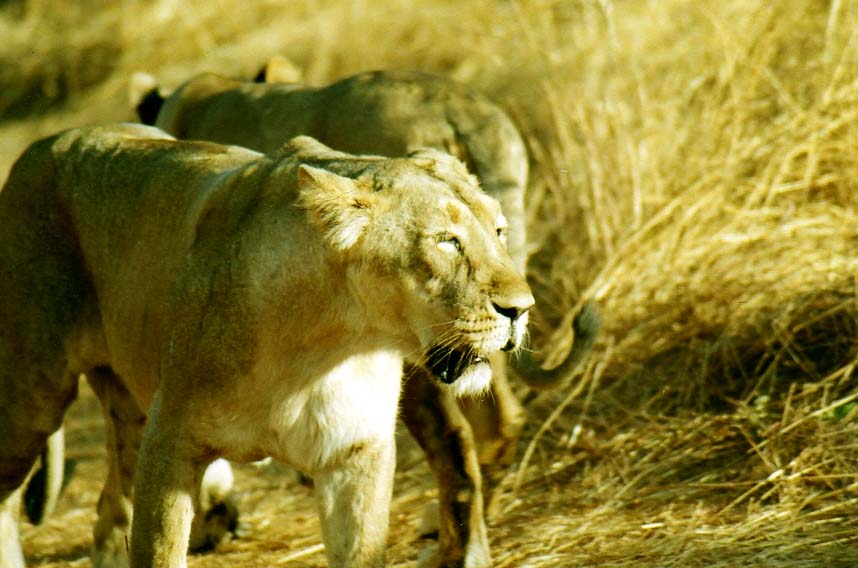
 We travelled through this area in search of Asiatic Lions, and although the forests of Sasan Gir were our ultimate destination, I was beginning to get a distinct feeling that we were now entering an area of real, primeval wilderness.
The grasslands were bathed in a suffocating, impenetrable heat haze, and searing temperatures dogged us incessantly, draining our energy before we could even pick up our cameras and get to work. Velavadar is a stronghold of the majestic Black Buck – reputedly the fastest antelope over long distances and a highly protected species – by royal decree.

Having almost been wiped out by overzealous hunters in the last century, the Black Buck is enjoying a comeback of sorts in India, if only through the committed work of local conservationists. The reserve is carefully managed, and the species so precious that they are further protected from their natural predators by the wildlife department. Jackals though, and the extremely rare Indian Wolf still make enough of an impact to strike some kind of equilibrium in the numbers.
We were not staying here for long – there are no lions here – and we only wanted some coverage of the Black Bucks to fill in some back story to the main show. And besides, we had arrived out of the breeding season, so the gorgeous black and white adult males were not being as flamboyant with their advances towards the females – although the dominant stags spent most of their time putting sub-adult males in their place. With no cover from the heat, we were about to leave the black buck and head for the cover of the forests, but then we all stopped what we were doing when a strange figure materialized on the horizon.

Out of the shimmering grass strode one of the most unusual looking animals I have ever seen. The mirage slowly began to take shape and for a moment I believed I was looking at a strange hump-backed, long-necked buffalo. But it was far from a strange, fantastical mutation. This was a very real, and very sacred Blue Bull, or Nilgai to give it its proper name. I have read about Nilgai and seen pictures of them, but to witness one in the wild – it almost seems like an improbable mixture of several different animals…

With a pair of devilish little horns adorning its head and a black beard sprouting from its neck, we were able to identify it as a male. He was uneasy, changing his posture regularly and sniffing the air. His uneasiness was caused by an adjacent herd of lighter-coloured females. His behaviour suggested that at least one of them was in breeding condition. Our presence, all loaded into a big grey Land Rover, may have also been causing him some nerves, so we pulled away, and left him to his potential exploits…
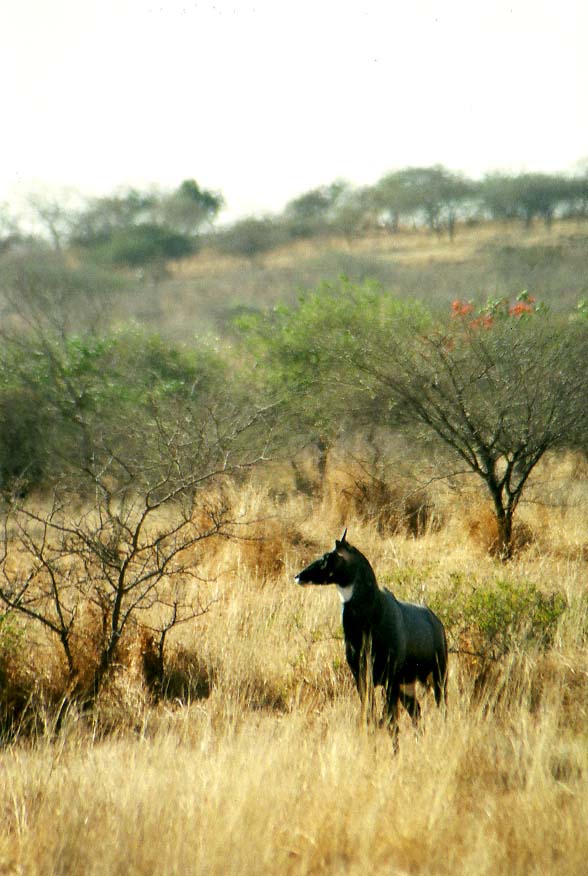 Full-grown male Nilgai, reputedly are pound-for-pound, one of the strongest antelope species in the world, but I’m not sure how such a statement is either gauged or measured. But what I do know is that they are a very regal-looking animal. The males in particular make an imposing sight. When we finally reached Gir, we came across a number of other individuals – but one battle-worn male particularly stood out from the rest.
Like a proven prize-fighter, one of his horns was dramatically broken, and his thick neck was scarred and streaked from run-ins with rivals or predators, or both.
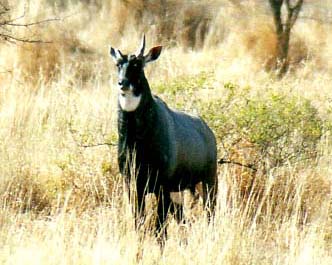
His beard was long and his blue-black coat positively glistened in the sun – he was quite a striking sight, and he seemed to know it.
This male too was hanging around a female, with calf in tow. She seemed to be pregnant as well, so I’m not sure why the male was hovering around them. But he was on full alert, so mesmerized by scanning the horizon that he totally overlooked our presence.
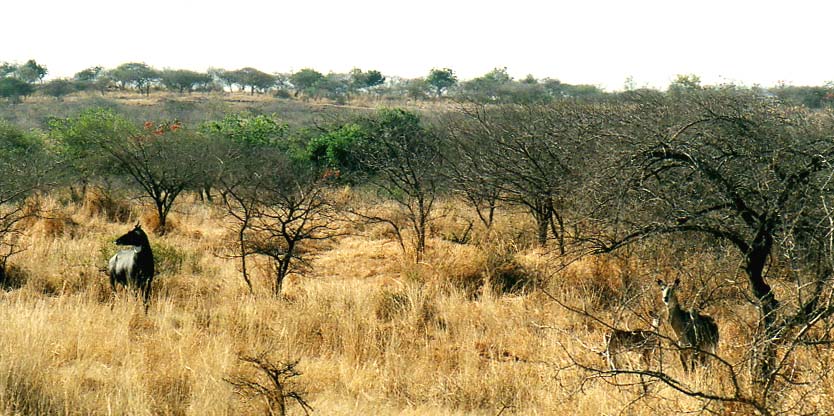
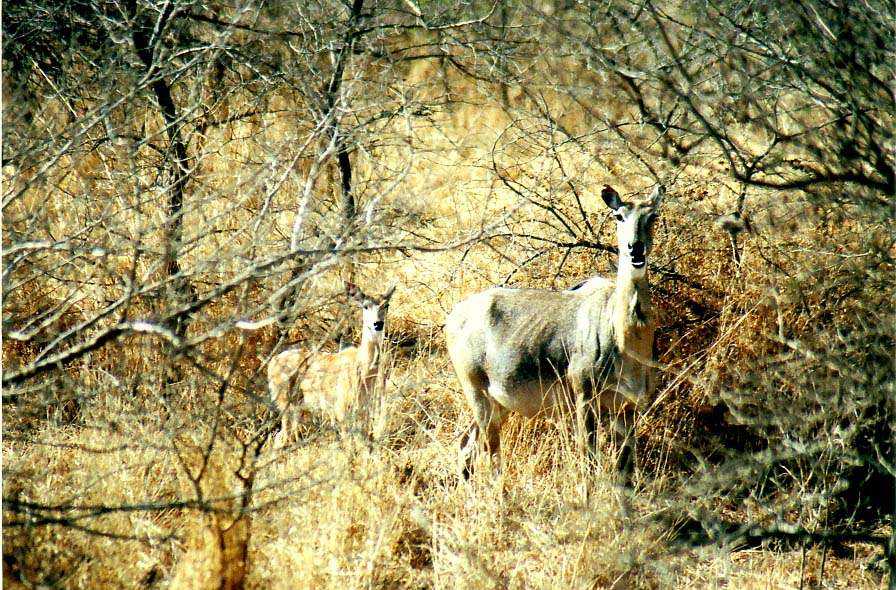
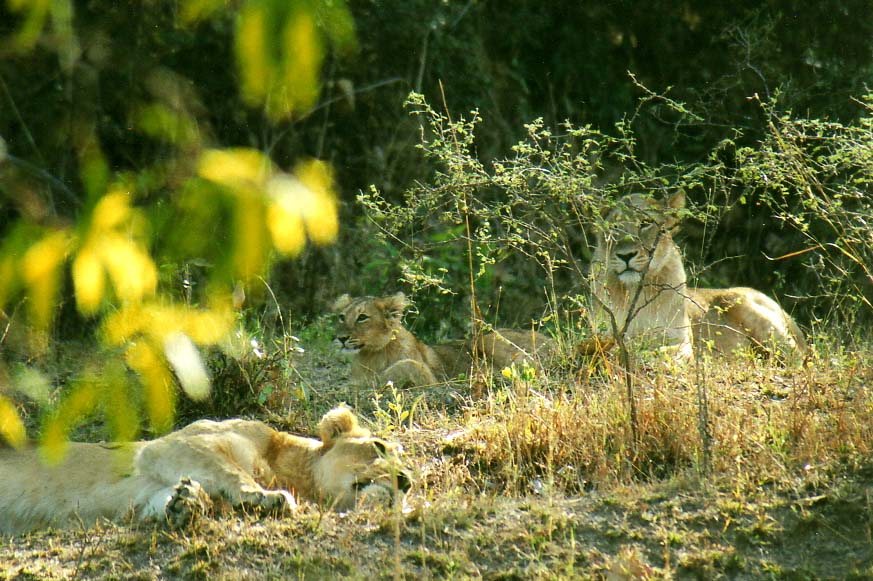
A small pride of lions had been enjoying their mid-morning siesta about a mile away, and although he couldn’t see them, the old Nilgai could certainly smell the felines. Nilgai are fully equipped to survive in a place with lions and tigers for neighbours. Apart from their bulk, they are capable of attaining prolonged speeds of up to 30 miles an hour, and have very sharp eyesight.
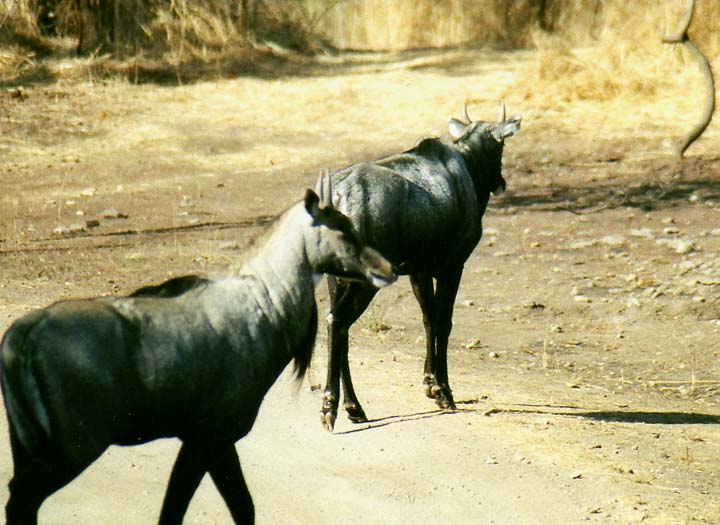
By early evening, we encountered a pair of bachelor bulls, who were in their prime and muscled up like the 500-pound heavyweights they were. But a sudden change in the wind, and they were off, along with the female they were following...
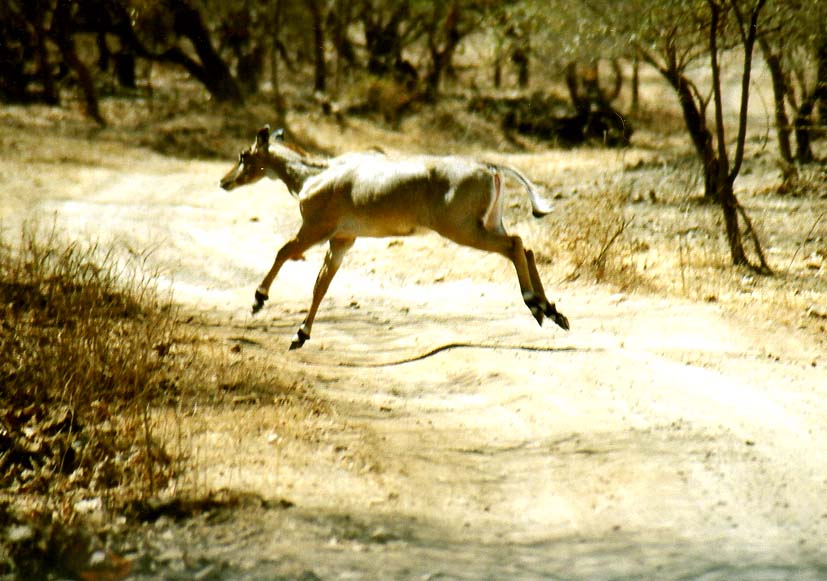
The matriarch lioness had roused her family and they were on the move… As dusk settled, even the formidable Nilgai withdrew from centre stage and sought out the sanctuary of the undergrowth – still the best tactic when a Lion has dinner on its mind…
All photos (c) copyright, Charith Pelpola
Wednesday, November 29, 2006
The Making of Spirit Bear #3: The Old Girl
When I finally got round to fine-tuning the narrative for our documentary, it was vital that we had a semblance of a "cast" - characters on whose lives we could eavesdrop if only for a fleeting moment in time, and tell their stories, from their point of view.
Well that was the plan anyway. And after our first season of filming and hardly any bears on the ground, I was beginning to wonder if this plan was as straightforward as it had seemed initially. But then the wilderness intervened as She usually does, and this year, out of the undergrowth stepped the Old Girl.

She is called "One Eye" in the documentary, for obvious reasons, and she was as wizened and beaten-up and bedraggled as an old sloth bear could get. Calloused and besieged by skin ailments, many would call her ugly and not give her even a second glance. But we fell in love with her, and she repaid our attentions by remaining in "our patch" of the forest for an entire week.
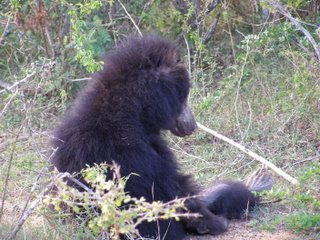
So for seven days we were given a glimpse into the life of a bear in her twilight years. Film-makers are often warned against the temptation to portray an animal's life or behaviour using a palette of human emotions - but how could we not be affected by the discomfort she displayed while walking on a badly injured paw, or the almost hopeless look of desperation that swept across her eyes when faced with the prospect of having to climb a tree despite her aching arthritic joints.
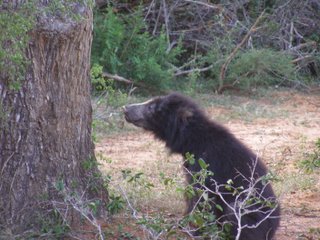
You could read that bear like a book. The fear of wandering into a younger bear's territory, or being ambushed by another. The seemingly hopeless search for food, and the fatigue that she obviously felt after hours spent stumbling under a sweltering sky.
So with the visuals we came back with, her story slowly unfolded - I didn't have to tell the Old Girl's story - she told it herself. And when at last she disappeared into the bush for the final time, we felt like we were saying goodbye (and good luck) to a friend, whom we knew we would never see again.
Well that was the plan anyway. And after our first season of filming and hardly any bears on the ground, I was beginning to wonder if this plan was as straightforward as it had seemed initially. But then the wilderness intervened as She usually does, and this year, out of the undergrowth stepped the Old Girl.

She is called "One Eye" in the documentary, for obvious reasons, and she was as wizened and beaten-up and bedraggled as an old sloth bear could get. Calloused and besieged by skin ailments, many would call her ugly and not give her even a second glance. But we fell in love with her, and she repaid our attentions by remaining in "our patch" of the forest for an entire week.

So for seven days we were given a glimpse into the life of a bear in her twilight years. Film-makers are often warned against the temptation to portray an animal's life or behaviour using a palette of human emotions - but how could we not be affected by the discomfort she displayed while walking on a badly injured paw, or the almost hopeless look of desperation that swept across her eyes when faced with the prospect of having to climb a tree despite her aching arthritic joints.

You could read that bear like a book. The fear of wandering into a younger bear's territory, or being ambushed by another. The seemingly hopeless search for food, and the fatigue that she obviously felt after hours spent stumbling under a sweltering sky.
So with the visuals we came back with, her story slowly unfolded - I didn't have to tell the Old Girl's story - she told it herself. And when at last she disappeared into the bush for the final time, we felt like we were saying goodbye (and good luck) to a friend, whom we knew we would never see again.
Friday, November 24, 2006
A message from above
I thought today would be a bad day, considering the way it started: our much loved Suckermouth Catfish, Hypostomus plecostomus, imaginatively christened "Spotty" by my wife, had passed away during the night. I bought him as a 2 inch baby when we first came to Singapore in 2000, and 6 years later, he had grown into a handsome 2 and half feet giant.
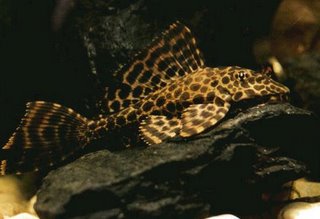
Farewell Spotty. We had good times...
I spent a sad morning burying the former King of the Castle in the garden. He (although 'plecos' are difficult to sex, so I was never sure about this) was a charismatic resident of the aquarium, regularly rearranging the scenery to suit his needs, and polishing off entire cucumbers by moonlight. The tank is much emptier following his demise...
Some might wonder how one could get so attached to a fish - but I'm afraid both of us are suckers for any animal - and especially those that enter our home, for they inevitably enter our hearts.
But on the upside, my "Buddies" are growing nicely, and my local aquarium shop-owner - don't know his name, so I shall call him Uncle Fish - presented me with a pair of Super Red Melon Discus, as he knew how upset I had been at my old pair's passing. Hopefully they will acclimatize and settle down.
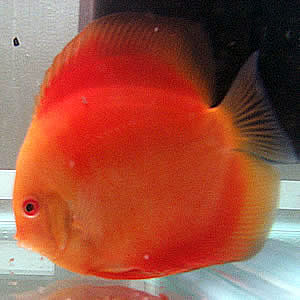
They look something like this...
Anyway I sought consolation in the last remaining pages of David Attenborough's "Life on Air" - yes it seems ridiculous but its taken me all this time to finally sit down and read it. As I finished his concluding chapter, I closed the book with a sigh of satisfaction. I reflected on his exploits and collected memories as I walked down the road this evening back home, and I thought to myself, Yes, to be touched by nature and the wilderness - that's all I could really ask for.
 As I thought this quite profound thought, I passed under a towering Sea Almond Tree, and one of its great big green nuts fell on my head.
It hurt.
Not quite what I had in mind by being "touched by nature", but appropriate nonetheless.
Yes, quite fitting actually...

Farewell Spotty. We had good times...
I spent a sad morning burying the former King of the Castle in the garden. He (although 'plecos' are difficult to sex, so I was never sure about this) was a charismatic resident of the aquarium, regularly rearranging the scenery to suit his needs, and polishing off entire cucumbers by moonlight. The tank is much emptier following his demise...
Some might wonder how one could get so attached to a fish - but I'm afraid both of us are suckers for any animal - and especially those that enter our home, for they inevitably enter our hearts.
But on the upside, my "Buddies" are growing nicely, and my local aquarium shop-owner - don't know his name, so I shall call him Uncle Fish - presented me with a pair of Super Red Melon Discus, as he knew how upset I had been at my old pair's passing. Hopefully they will acclimatize and settle down.
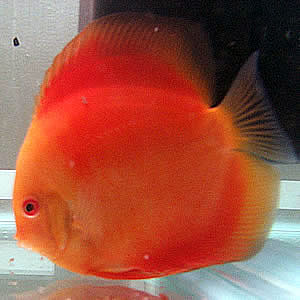
They look something like this...
Anyway I sought consolation in the last remaining pages of David Attenborough's "Life on Air" - yes it seems ridiculous but its taken me all this time to finally sit down and read it. As I finished his concluding chapter, I closed the book with a sigh of satisfaction. I reflected on his exploits and collected memories as I walked down the road this evening back home, and I thought to myself, Yes, to be touched by nature and the wilderness - that's all I could really ask for.
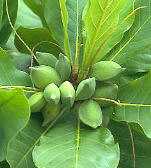 As I thought this quite profound thought, I passed under a towering Sea Almond Tree, and one of its great big green nuts fell on my head.
It hurt.
Not quite what I had in mind by being "touched by nature", but appropriate nonetheless.
Yes, quite fitting actually...
Saturday, November 18, 2006
The Making of Spirit Bear #2: Faces in the Crowd
There comes a moment in the jungles, after the first few days of frenzied surveillance and field research, when you settle down, figure out your likely locations, and just wait for things to happen. And that's the moment when the wilderness gradually starts to accept you as part of the landscape...
It was no different this time in Sri Lanka, while waiting for the stars of our show to make their grand entrance. And boy did we have to wait - but that was not necessarily a bad thing, because we had time to acquaint ourselves with other residents of the reserve - who spent as much time watching us, as we did them...
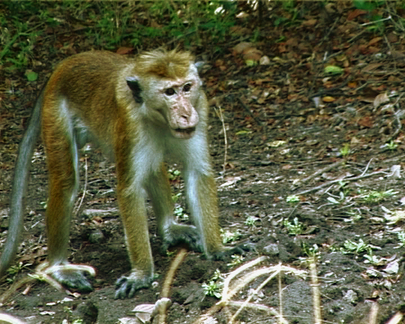
One of the most familiar faces in the foliage are Toque Macaques, a species endemic to Sri Lanka, but similar to the Bonnet Macaques of India. Each is characteristically distinguished by the curious "hairdo" (toque) that they possess.
The individual hairstyles are as unique as fingerprints, and are used to identify each macaque in field studies. Anyway it didn't take long before they allowed even the youngest members of their clan to come take a look at the strange bipedal monkeys...

Hello... who are these strange looking animals then?
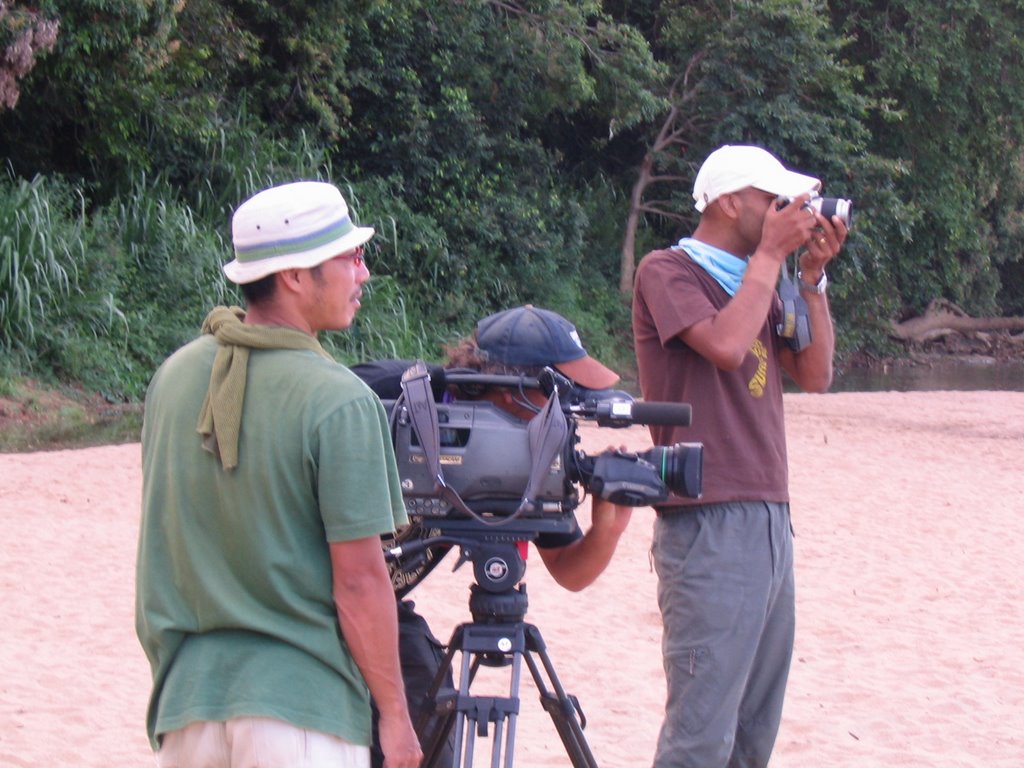
Not another herd of wildlife film-makers...

Oh well, better assume the "cute baby" pose then...
Cocoa and the Dragon
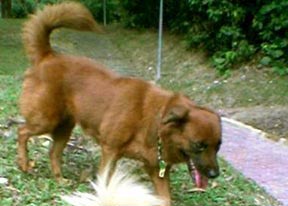 Cocoa is a curious sort. For those that don't know her, she's a typical "Singapore special" - mysterious parentage, but some recognizable breeds incorporated somewhere within her ancestry.
She's extremely inquisitive and when she's feeling up to it, inclined to bouts of cleverness.
Cocoa is very familiar with all the animal life that frequents our neighbourhood here in the west coast of the island. She has strong maternal instincts and is forever trying to make friends with any species that she comes across, and so far this has failed with the Mynah Birds, the Pigeons, the Orioles, the Plaintain Squirrels, and the Changeable Lizards. But these minor setbacks have never stopped the old girl, and today she found a new and highly unexpected potential-friend:
Subscribe to:
Posts (Atom)